.png?width=130&height=53&name=Vector%20(21).png "TermScout Logo")

Download Your Free Copy of the Contract Trust Report 2026
Link on the last page
Key Takeaways: AI Contract Intelligence
- AI contract intelligence analyzes agreements at the clause level and benchmarks terms against market data to surface actionable signals.
- Enterprise teams reduce review cycles significantly when they replace manual contract triage with structured, signal-driven workflows.
- TermScout's Certify platform combines AI analysis with human legal expert validation to deliver 99% contract signal accuracy.
- The most effective contract intelligence systems prioritize triage at intake, ongoing monitoring, and portfolio-level visibility.
- Transparent methodology and independent verification distinguish reliable platforms from generic AI tools that operate as black boxes.
What Enterprise Teams Should Know About AI Contract Intelligence
1. AI Contract Intelligence Turns Agreements Into Decision-Ready Data
Traditional contract evaluation requires someone on your team to read every agreement manually, flagging issues based on individual interpretation. AI contract intelligence changes this by extracting key terms automatically and converting dense legal language into structured signals.
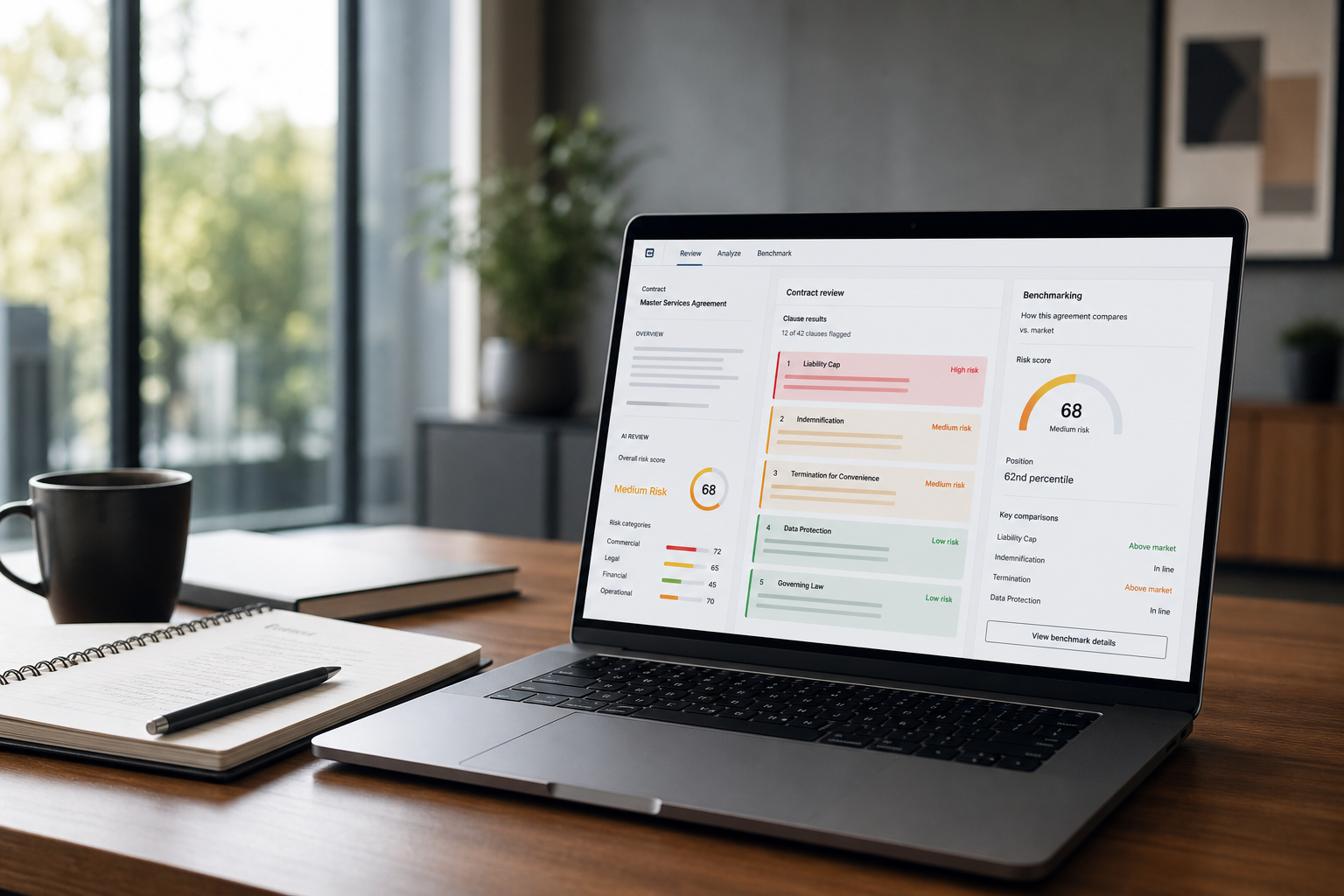
The technology examines contracts at the clause level, identifying provisions like liability caps, indemnity obligations, and termination rights. It then benchmarks those provisions against thousands of real-world agreements to show where your terms fall relative to market standards.
This structured output allows legal and procurement teams to act on contract data immediately rather than spending weeks in manual analysis.
2. Contract Triage Becomes Systematic Rather Than Case-by-Case
When a new vendor agreement arrives, most teams add it to a queue and review contracts in the order they arrived. AI contract intelligence enables intelligent routing based on actual risk signals and term complexity.
Low-risk agreements that match market standards move forward quickly. High-risk agreements with unusual terms get flagged for deeper legal review. The result is faster overall throughput without compromising risk management.
TermScout's Certify Triage capability generates contract signals that show which agreements need escalation, which can proceed, and where terms fall outside market norms.
3. Market Benchmarking Replaces Opinion-Based Negotiation
Contract negotiations often stall because parties debate whether specific terms are "reasonable" based on competing opinions. AI contract intelligence changes this dynamic by introducing objective market data into the conversation.
When you can show exactly how a vendor's liability position compares to thousands of similar agreements, discussions shift from subjective interpretation to verifiable evidence. Vendors find it harder to insist on outlier terms when confronted with data showing their position differs significantly from accepted practice.
This data-backed positioning shortens redline cycles because both parties can see where terms genuinely deviate from market norms.
4. Human Expert Validation Addresses the Black Box Problem
Many AI tools generate outputs without explaining how they reached their conclusions. For legal professionals managing organizational risk, this opacity creates serious adoption barriers.
Reliable contract intelligence platforms address this by combining AI analysis with human legal expert validation. TermScout's approach involves legal professionals who verify AI-generated insights, ensuring accuracy, consistency, and methodological transparency.
This hybrid approach delivers accuracy that neither AI nor manual review achieves alone. Teams can examine and trust the reasoning behind every contract signal.
5. Contract Monitoring Extends Beyond Initial Review
Contract intelligence creates value throughout the agreement lifecycle, not just during initial negotiation. Platforms that monitor agreements over time detect when vendor terms change in renewal contracts, when obligations shift, or when risk profiles evolve.
TermScout's Certify Monitor capability highlights when contract terms drift away from approved positions. This ongoing visibility prevents surprises during renewals and supports audit preparation by maintaining a documented record of how agreements have changed.
For enterprise teams managing hundreds of vendor relationships, this ongoing intelligence prevents risk accumulation that manual tracking cannot catch.
6. Independent Certification Creates External Trust Signals
Beyond internal analysis, contract intelligence enables independent certification that agreements meet recognized standards. This external validation helps both buyers and sellers move faster through approval processes.
TermScout's TrustMark certification verifies that an agreement is fair, balanced, and market-aligned. When counterparties see this certification, they enter negotiations with confidence that the terms have been independently evaluated rather than relying solely on the vendor's assertion.
For sales teams, this certification reduces the friction that stalls deals at the contract stage. Xactly reduced sales cycle times by 80% and Freshworks reduced sales negotiations by 40% using this approach.
7. Portfolio-Level Visibility Enables Strategic Decision-Making
Individual contract analysis is valuable, but enterprise teams need visibility across their entire agreement portfolio. Contract intelligence platforms aggregate signals to show patterns, concentration risks, and vendor-level trends.
TermScout's Certify Profile capability benchmarks contract positions across agreements, enabling side-by-side vendor comparison and risk concentration analysis. This portfolio view helps procurement leaders make consistent decisions rather than treating every contract as an isolated evaluation.
For organizations managing complex vendor ecosystems, this strategic visibility transforms contracts from administrative overhead into governance infrastructure.
Why AI Contract Intelligence Matters for Enterprise Teams
Enterprise legal and procurement teams face mounting pressure to support deal velocity without adding headcount. AI contract intelligence addresses this challenge by making agreement terms visible, comparable, and actionable at scale.
TermScout delivers contract intelligence through Certify, its AI-powered platform that analyzes commercial contracts, benchmarks language against market standards, and surfaces signals that accelerate decisions. Combined with TrustMark certification, this approach reduces negotiation friction and builds confidence with counterparties.
If your team needs to triage contracts faster, benchmark terms against real market data, or demonstrate agreement fairness to buyers, TermScout gives you the intelligence infrastructure to make that happen. Explore how Certify works for your organization.
FAQs about AI Contract Intelligence
What is AI contract intelligence?
AI contract intelligence uses artificial intelligence to extract, analyze, and benchmark terms from legal agreements. The technology examines contracts at the clause level, compares provisions against market standards, and generates signals that help teams identify risks and prioritize review efforts.
TermScout's Certify platform delivers this analysis with 99% contract signal accuracy by combining AI with human legal expert validation.
How does AI contract intelligence differ from manual review?
Manual review requires someone to read every agreement line-by-line, flagging issues based on individual interpretation. AI contract intelligence automates the analysis, comparing terms against thousands of real-world agreements to surface deviations and risks automatically.
This shifts legal and procurement teams from document processors to strategic decision-makers who focus on the issues that genuinely require human judgment.
What types of contracts can AI contract intelligence analyze?
AI contract intelligence platforms analyze most common business agreements including NDAs, DPAs, IT agreements, service contracts, and vendor agreements. The technology examines liability structures, indemnity provisions, termination rights, and governance clauses.
TermScout's Certify system handles both incoming vendor contracts and outgoing sales agreements with equal analytical depth.
How accurate is AI contract analysis?
According to research from Loio, AI can analyze a standard NDA in 26 seconds compared to 92 minutes for manual lawyer review, achieving 94% accuracy. TermScout combines AI analysis with human legal expert validation to deliver 99% contract signal accuracy.
This hybrid approach outperforms either method used alone by catching issues that pure automation might miss.
What should enterprise teams look for when evaluating contract intelligence platforms?
Evaluate platforms based on extraction accuracy, benchmarking data quality, methodology transparency, and integration capabilities. Ask vendors to demonstrate analysis on your actual contracts and explain how their AI reaches conclusions.
TermScout differentiates through transparent methodology, independent TrustMark certification, and market benchmarking against thousands of real agreements.
How does contract intelligence reduce negotiation cycles?
Contract intelligence shortens negotiations by replacing opinion-based debates with data-backed discussions. When you can show that a vendor's liability position differs significantly from market standards, negotiations focus on objective evidence rather than subjective interpretation.
TermScout customers report reducing sales negotiations by up to 40% and sales cycle times by up to 80% using this approach.

Gautam Joshi
Founding Growth Manager
Gautam Joshi, Founding Growth Manager at TermScout leverages marketing expertise by combining data-driven brand strategy, messaging, demand generation, and sales enablement to boost revenue and streamline deals.
Share this

What Is Contract Certification for Vendor Risk Teams

Fair Contract Certification in Vendor Risk Management