
Vendor risk programs measure cybersecurity posture, financial stability, and regulatory compliance with increasing rigor. Most of them, however, skip one critical dimension: whether a vendor's contract terms are actually fair and market-aligned.
That gap leaves legal and procurement teams approving agreements based on incomplete risk signals. Fair contract certification closes this blind spot by applying objective, data-backed benchmarks to vendor agreements, giving your team structured evidence of contract fairness before approvals move forward.
This guide breaks down how fair contract certification works within third-party risk and compliance workflows, what it evaluates, and how to integrate certification evidence into your vendor onboarding and ongoing governance processes.
Key Takeaways: Fair Contract Certification for Vendor Risk
- Fair contract certification independently verifies that vendor agreements meet market standards for balanced terms and proportional risk allocation.
- Traditional vendor risk scoring overlooks contract-level fairness, creating a blind spot in procurement approvals and compliance documentation.
- Certification produces structured, auditable evidence that supports regulatory responses and internal governance requirements across industries.
- TermScout's TrustMark™ certification combines AI-powered benchmarking with human legal validation for objective contract fairness verification.
- Integrating certification into third-party risk workflows creates repeatable evaluation criteria that reduce review cycles and negotiation friction.
What Is Fair Contract Certification?
Fair contract certification is an independent verification process that evaluates whether a commercial agreement distributes risk, obligations, and protections in a way that aligns with prevailing market norms. The outcome is a structured, binary determination: the agreement either meets the fairness threshold or it does not.
This clarity distinguishes certification from opinion-based assessments. Where traditional evaluations depend on individual reviewer judgment, certification anchors its findings in benchmarking data derived from thousands of real-world agreements. Each provision is measured against documented market standards rather than subjective interpretation.
The evaluation typically covers liability allocation, indemnification structures, termination rights, data security commitments, and service level obligations. These are the contract elements that carry the most financial and operational consequence when they deviate from what comparable organizations typically accept.
Why Vendor Risk Programs Need Contract Fairness Evidence
Most third-party risk management frameworks assess vendors across operational categories: information security controls, business continuity readiness, financial health indicators, and regulatory compliance status. These dimensions are essential. They also leave a significant vulnerability unaddressed.
A vendor can score well on every operational risk metric while presenting contract language that includes disproportionate liability exposure, aggressive auto-renewal provisions, or one-sided indemnification obligations. Your risk score signals safety. The contract introduces risk your scoring model never measured.
According to the ISACA 2025 analysis on vendor risk assessments, risk can arise from inadequate security practices, compliance violations, and operational disruptions, all of which trace back to how contract terms allocate responsibility between parties. Contract fairness evidence fills that analytical gap.
How Contract Fairness Fits into Third-Party Risk Frameworks
Contract fairness functions as the final validation layer in a comprehensive risk framework. Your team has already confirmed the vendor's security posture, financial health, and compliance standing. Certification confirms that the agreement itself does not introduce hidden risk through unfavorable or non-standard terms.
This layer answers questions that operational assessments cannot address: Are liability caps proportional to the contract value? Does the indemnification language allocate responsibility in a way that matches market norms? Do termination provisions give both parties reasonable exit flexibility?
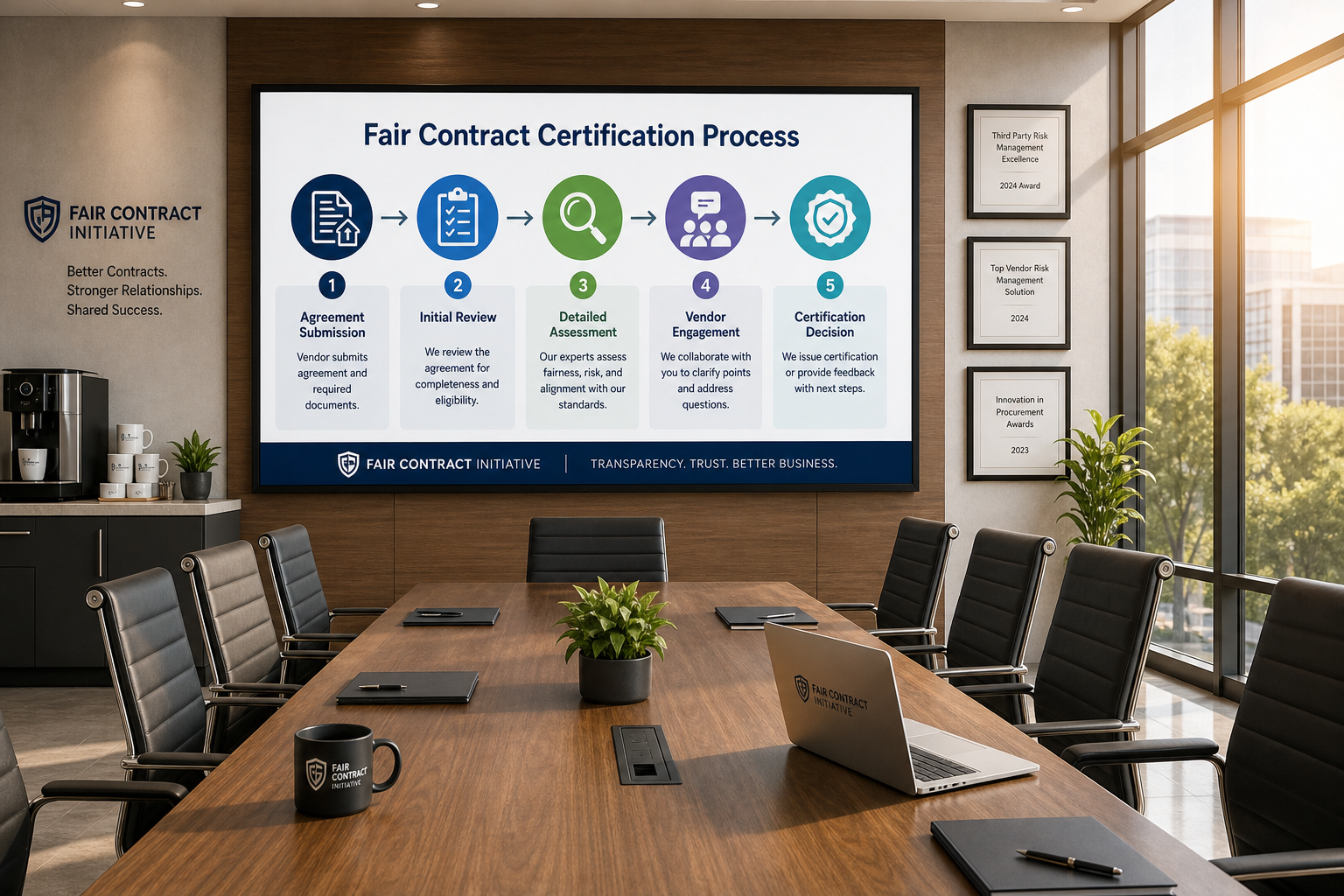
How Fair Contract Certification Works Step by Step
The certification process follows a structured methodology that combines automated analysis with expert validation. Each step builds on the previous one to produce a defensible, evidence-based outcome.
Step 1: Agreement Submission and Intake
The vendor's standard agreement is submitted for evaluation. Submission can happen at any point in the supplier onboarding process, though earlier placement produces faster overall approval timelines.
Common agreement types that undergo certification include master services agreements, NDAs, data processing agreements, and IT service contracts. The methodology accommodates most commercial agreement structures used in B2B vendor relationships.
Step 2: AI-Powered Clause-Level Analysis
The agreement is analyzed at the individual clause level using AI-powered contract intelligence. Each provision's function, scope, and risk allocation pattern is identified and categorized automatically.
TermScout's Certify™ platform processes agreements using structured contract intelligence that flags deviations from market norms at the clause level. The system generates Contract Signals that identify provisions falling outside normal ranges or representing potential deal breakers.
Step 3: Market Benchmarking Against Real Agreements
Each analyzed provision is benchmarked against a database of thousands of real-world agreements. This comparison reveals exactly where the vendor's terms stand relative to what similar organizations typically accept in comparable contract categories.
Benchmarking answers the question procurement teams need resolved most urgently: Is this term standard, or is it an outlier that requires negotiation attention? Market data replaces guesswork with structured evidence.
Step 4: Human Legal Expert Validation
AI analysis alone is not sufficient for certification. Human legal experts validate the automated results, confirm accuracy on nuanced provisions, and apply professional judgment to edge cases where automated systems require additional context.
This hybrid approach gives the certification process both the scalability of AI-powered analysis and the reliability of human legal oversight. TermScout combines AI analysis with human expert validation to deliver verified accuracy in contract signal detection.
Step 5: Certification Decision and Documentation
Based on the analysis and benchmarking results, the agreement receives its certification status. Contracts rated Balanced or Customer Favorable that contain zero deal-breaker clauses qualify for TrustMark™ certification.
The certification outcome is documented in a structured report showing exactly how the agreement benchmarks against market standards. This documentation supports audit requirements, regulatory responses, and internal governance needs with verifiable, objective evidence.
What Fair Contract Certification Evaluates
Understanding which contract provisions certification examines clarifies why it catches risks that operational assessments miss. Each evaluation category targets a specific dimension of contract fairness with direct business consequence.
Liability Allocation and Caps
Certification evaluates whether liability caps are proportional to the contract value and consistent with industry norms. A vendor proposing a liability cap far below market standard creates financial exposure that your risk program should identify and quantify.
The evaluation considers both the cap structure and any exclusions from the cap. Unlimited liability carve-outs for certain categories can dramatically alter actual exposure even when the headline cap appears reasonable.
Indemnification Structures
Indemnification clauses determine who bears financial responsibility when issues arise. Certification assesses whether the scope of indemnification obligations is proportional to each party's role and aligned with what comparable agreements typically include.
Unbalanced indemnification, where one party absorbs nearly all risk, is a common source of negotiation delays. Identifying these imbalances before negotiations begin focuses legal attention on the provisions that require adjustment.
Data Security and Privacy Commitments
Contractual commitments around data handling have become a critical evaluation category as data protection requirements expand. Certification examines whether data security provisions meet current market expectations for the contract type.
This includes data breach notification timelines, data processing limitations, security audit rights, and data return or destruction obligations upon contract termination. Each provision is measured against what the market standard reflects for similar agreements.
Termination Rights and Exit Provisions
Certification assesses whether both parties have reasonable options to exit the relationship. Aggressive lock-in provisions, excessive early termination penalties, or automatic renewal terms with limited opt-out windows all reduce contract fairness and increase operational risk.
Unfavorable termination terms can keep your organization bound to vendor relationships that no longer serve strategic objectives. Identifying these provisions during the certification process enables informed decisions before commitment.
How Certification Strengthens Supplier Onboarding
Supplier onboarding is where contract certification delivers its most immediate operational value. The process typically involves multiple approval gates, and contract evaluation is almost always the bottleneck that extends timelines.
Accelerating Onboarding Cycle Time
When a vendor presents a certified agreement, your procurement team gains immediate confidence that the terms meet market standards. That confidence translates directly into faster approvals because the structured evidence replaces the need for extended independent analysis.
Certification status enables your team to triage incoming contracts effectively. Certified agreements move forward through expedited paths. Non-certified agreements receive the additional scrutiny their risk profile requires.
Creating Consistent Evaluation Standards
One of the most persistent challenges in supplier onboarding is evaluation inconsistency. Different reviewers apply different standards to the same contract provisions. What one attorney flags as concerning, another may approve without further comment.
Certification creates a uniform standard that applies across all vendor agreements. Every contract is measured against the same market benchmarks, producing consistent outcomes regardless of which team member performs the evaluation.
Supporting Governance and Audit Documentation
Regulatory expectations for third-party oversight continue to increase. The Basel Committee's 2025 principles for third-party risk management explicitly address contracting as a distinct governance category, requiring documented evidence that vendor agreements were evaluated against recognized standards.
A certification report delivers that documentation. It shows the methodology, the benchmarks applied, and the outcome in a format that satisfies both internal governance requirements and external audit expectations.
How to Integrate Certification into Your Risk Program
Adding contract certification to an existing third-party risk management framework requires intentional placement and clear triggering criteria. Positioning certification strategically maximizes its impact on onboarding speed and risk coverage.
Define Your Certification Triggers
Not every vendor agreement requires formal certification. Establish clear criteria for which contracts go through the process. Common triggers include contracts above a defined dollar threshold, vendors with access to sensitive data, and agreements involving critical business functions.
A risk-based approach ensures you apply certification where contract terms carry the most financial and operational impact while keeping lower-risk agreements moving through standard evaluation.
Position Certification Early in the Onboarding Workflow
Place certification before detailed negotiations begin. When your team knows a vendor's standard terms are already certified as fair, the extended back-and-forth that typically adds weeks to onboarding timelines becomes unnecessary.
For vendors whose contracts are not yet certified, the certification analysis still provides targeted value. It identifies exactly which provisions need attention, enabling focused negotiation rather than full-contract redlining.
Connect Certification Data to Existing Risk Scores
Integrate certification outcomes into your existing vendor risk scoring model. A vendor's contract fairness status should be visible alongside their security, compliance, and financial risk metrics, giving decision-makers a complete picture in a consolidated view.
TermScout's Certify™ Profile aggregates contract intelligence across all vendor agreements, enabling portfolio-level visibility into contract risk alongside other third-party risk management data.
Certification vs. Self-Assessment in Vendor Contracts
Vendors frequently describe their contracts as "market standard" or "fair" during onboarding discussions. Without independent verification, these claims are impossible to evaluate objectively. This distinction is where certification creates value that self-assessment cannot match.
Why Independent Validation Carries More Weight
Self-assessment carries inherent bias. A vendor has financial incentives to describe their terms favorably, even when specific provisions deviate from market norms. Independent certification removes that bias by applying third-party evaluation against objective, data-driven standards.
For procurement teams, this distinction matters operationally. Independent validation means your team can trust the certification result without performing redundant internal analysis. The certification carries weight precisely because it comes from outside the transaction.
How Transparent Scoring Methodology Builds Trust
TermScout's certification process publishes exactly how each agreement was evaluated. The scoring methodology is visible, the benchmarking data is drawn from real agreements, and the human legal experts who validate results carry professional accountability for their findings.
This transparency differentiates independent certification from opaque scoring systems where the underlying methodology is not visible. When both parties access the same objective data, trust between vendor and buyer forms earlier in the relationship, reducing adversarial dynamics.
Measuring the Business Impact of Contract Certification
Contract certification creates measurable outcomes across several dimensions that matter to legal and procurement leadership. These outcomes compound as certification becomes a standard part of your vendor evaluation process.
Reduced Approval Timelines
When counterparties trust that contract terms have been independently validated, the negotiation phase compresses. Certified agreements move through procurement approval gates faster because the objective evidence base reduces the need for extended back-and-forth on individual provisions.
This acceleration benefits both sides of the transaction. Vendors recognize revenue sooner. Buyers onboard critical suppliers within tighter operational timelines.
Focused Legal Attention on High-Risk Provisions
Every hour your legal team spends analyzing provisions that already meet market standards is an hour redirected from strategic work. Certification concentrates legal attention on the specific provisions that genuinely require negotiation or adjustment.
For organizations managing high contract volumes, this efficiency gain compounds across the portfolio. Fewer escalations, fewer redline cycles, and fewer extended negotiations reduce the total cost of vendor onboarding.
Stronger Vendor Relationships from Day One
Starting a vendor relationship with an objective fairness assessment sets a collaborative tone from the outset. Both parties enter the engagement knowing that terms have been independently verified, which replaces adversarial negotiation dynamics with shared confidence.
Vendors who earn certification also gain competitive advantage in their own market. The credential signals to buyers that the vendor invests in maintaining fair, market-aligned terms as a standard business practice.
Common Misconceptions About Contract Certification
Several misunderstandings prevent organizations from adopting fair contract certification. Addressing them directly helps your team make an informed evaluation of certification's role in your risk program.
Does Certification Mean Every Term Is Identical?
A certified contract does not mean both parties have identical terms. Certification confirms that the agreement distributes risk and obligations in a way that aligns with market norms. Vendors may retain protections appropriate to their role, and buyers may hold specific rights that reflect their position in the transaction.
Fairness means market alignment and proportional risk allocation, not mathematical equality between parties.
Does Certification Replace Legal Judgment?
Certification supplements legal judgment rather than replacing it. It gives your legal team structured intelligence that focuses their attention on provisions that require negotiation. Certified agreements still go through your standard approval process, with less time spent on terms that already meet market standards.
The certification report serves as an intelligence layer that makes existing legal workflows more efficient, not a substitute for professional review on complex or non-standard provisions.
Is Certification Only Relevant for Large Enterprises?
Organizations of any size benefit from objective contract fairness evidence. Smaller teams often gain the most value because they have less legal capacity to perform deep contract analysis on every vendor agreement. Certification provides the structured intelligence that enables smaller procurement functions to evaluate terms with the same rigor as larger organizations.
The Future of Contract Certification in Risk Programs
Contract certification is evolving alongside the broader third-party risk management landscape. Several developments will shape how organizations apply certification evidence in vendor governance.
Ongoing Certification Monitoring
Static, point-in-time certification is giving way to continuous monitoring that tracks whether vendor terms remain fair as agreements renew or undergo amendments. Persistent contract intelligence flags when terms drift away from market standards over the lifecycle of the relationship.
This evolution transforms certification from a one-time evaluation into a living assessment that keeps your risk picture current throughout the vendor relationship.
AI-Specific Contract Provisions
As AI service agreements become a standard part of vendor portfolios, certification is expanding to evaluate AI-specific terms: model ownership, training data usage, output liability, and disclosure obligations. TermScout already offers AI Terms Certification to address these emerging contract categories.
Early certification coverage of AI contract terms positions your organization ahead of regulatory requirements that are emerging across major jurisdictions, providing governance documentation before mandates take effect.
Integration with Procurement Automation
Certification data will increasingly feed directly into automated procurement workflows. When a vendor submits a certified agreement, the system can route it through expedited approval paths without manual intervention. Non-certified agreements follow the standard evaluation track.
This automation removes bottlenecks while maintaining appropriate oversight. The certification status serves as the structured decision signal that enables process automation with confidence.
In Conclusion: Building Contract Fairness into Your Vendor Risk Program
Fair contract certification fills a critical gap in third-party risk and compliance programs. Traditional risk scoring tells you whether a vendor is operationally sound. Certification tells you whether their contract terms are fair, balanced, and aligned with what the market accepts.
For legal and procurement teams managing growing vendor portfolios, certification creates the consistency, speed, and defensibility that opinion-based contract evaluation cannot deliver. When your team can point to independent, data-backed validation of contract fairness, approvals move faster and vendor relationships start on stronger footing.
TermScout delivers that independent proof through TrustMark™ certification, combining AI-powered benchmarking with human expert validation to produce contract fairness evidence your team can trust and act on. Book a demo to see how certification strengthens your vendor risk program.
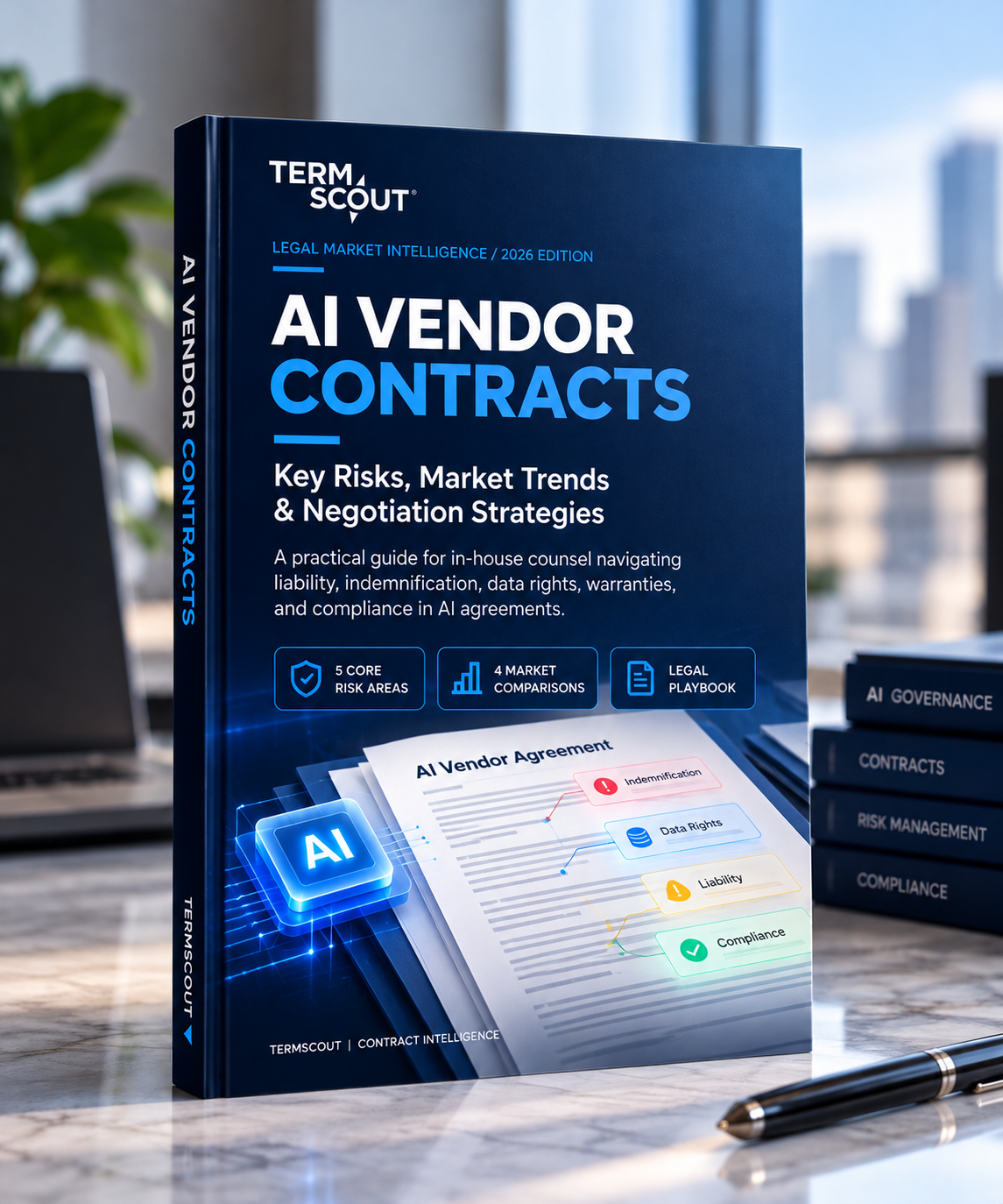
Download Your Free Copy of the AI Vendor Contracts Guide
Click here
FAQs About Fair Contract Certification for Vendor Risk
What is fair contract certification in vendor risk management?
Fair contract certification is an independent evaluation that verifies whether a vendor agreement meets market standards for balanced terms and proportional risk allocation. TermScout's TrustMark™ certification analyzes agreements at the clause level and benchmarks them against thousands of real contracts to produce an objective fairness determination.
How does fair contract certification differ from vendor risk scoring?
Vendor risk scoring evaluates operational factors like cybersecurity posture, financial stability, and compliance status. Fair contract certification evaluates the actual legal terms in the vendor's agreement, answering whether those terms are fair relative to what the market considers standard for that agreement type.
Can contract certification accelerate supplier onboarding timelines?
Certified agreements move through procurement approvals faster because independent validation removes the need for extended internal analysis. TermScout's certification data gives procurement teams structured proof that terms are market-aligned, reducing legal escalations and shortening the approval cycle.
What types of vendor agreements qualify for certification?
Most commercial agreement types qualify, including master services agreements, NDAs, data processing agreements, SaaS subscription contracts, and IT service agreements. The evaluation applies structured benchmarking criteria adapted to each agreement type and its specific risk profile.
Does fair contract certification replace the need for legal teams?
Certification supplements legal judgment by providing structured contract intelligence that focuses attorney attention on provisions requiring negotiation. TermScout's Certify™ platform surfaces the specific clauses that fall outside market norms, enabling legal teams to prioritize their time on high-impact provisions rather than standard terms.

Gautam Joshi
Founding Growth Manager
Gautam Joshi Founding Growth Manager at TermScout leverages marketing expertise by combining data-driven brand strategy, messaging, demand generation, and sales enablement to boost revenue and streamline deals.