.png?width=130&height=53&name=Vector%20(21).png "TermScout Logo")

The Contract Isn't the Deliverable. The Decision Is.
I had a customer conversation recently that has been rattling around in my head ever since.
The customer was showing us how they use TermScout.
I expected to hear about contract clauses.
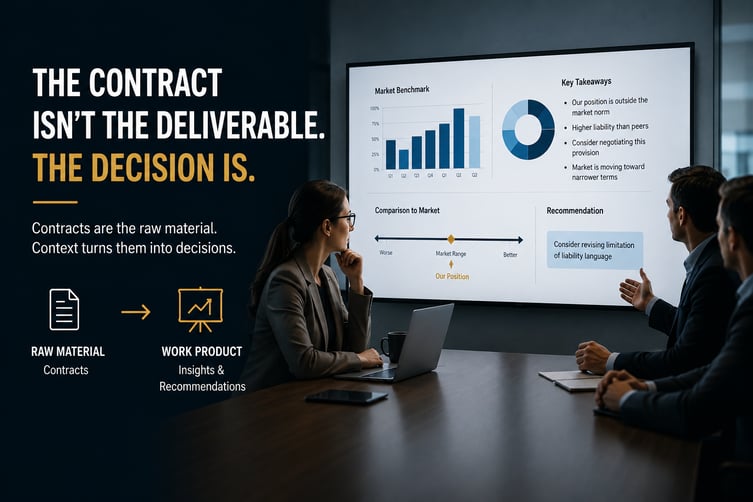
Instead, they showed me PowerPoint slides.
Lots of PowerPoint slides.
At first, I thought they were showing us a reporting workflow.
What they were actually showing us was how decisions get made.
The customer explained that when someone reaches out from legal leadership, procurement, finance, or the business, they are rarely asking:
"What does the contract say?"
They're usually asking something else.
● How do we compare to the market?● Are we outside the norm?
● Is this something we should change?
● What are we missing?
The contract is part of the answer, but it isn't the answer.
What struck me was that nobody was asking to see a contract,they were asking for a recommendation.
The slides were the work product.
The contracts were the raw material.
That distinction matters.
For years, contract technology has focused on helping people find things faster.
● Find the clause.
● Find the language.
● Find the risk.
Those are useful capabilities.
But that's not where most decisions happen.Decisions happen when someone has enough context to understand what the language means.
Is this common?
Is this unusual?
Is this worth negotiating?
Is this a hill to die on?
Is the market moving in a different direction?
Those are the questions that actually drive action.
The Search for Context, Not Contracts.
The more customer conversations I have, the more I hear the same thing.
People are not looking for more contract language.
They're looking for context.
They're looking for benchmarks.
They're looking for signals.
They're trying to understand what a contract reveals about risk, trust, leverage, and market position.
In other words, they're trying to make a decision.
Contracts Are Full of Signals
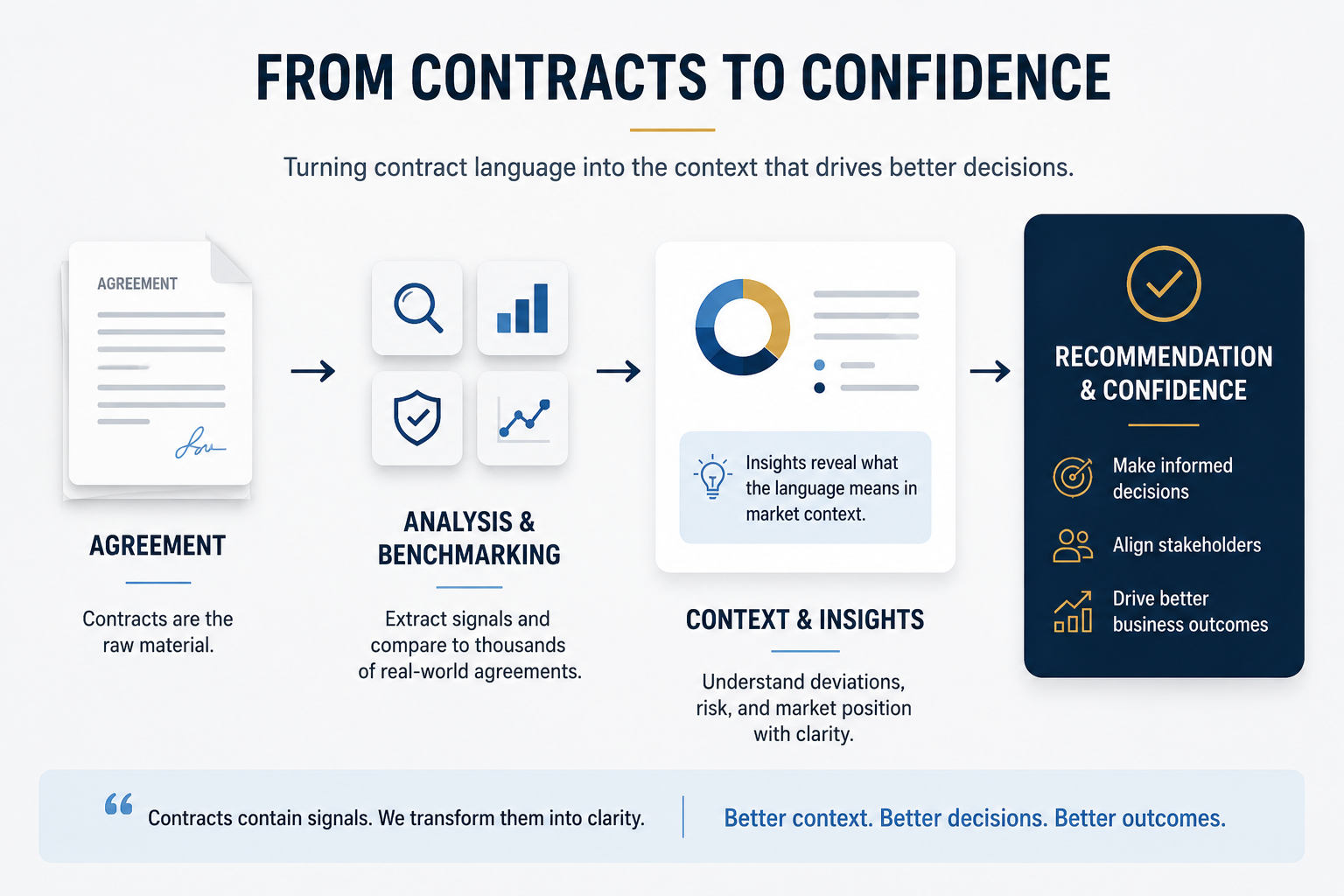
That's one of the reasons we've been spending so much time thinking about signals at TermScout. Contracts contain an enormous amount of information, and the main challenge is understanding what it means.
A limitation of liability clause isn't interesting because it exists, it's interesting because it tells you something.
About negotiating posture.
About risk tolerance.
About customer expectations.
About how a company thinks.
The same is true across an entire agreement.
Contracts are full of signals.
The question is whether we can help people see them.
The Outcome Behind the Contract
The customer never intended to give us product feedback, they were simply showing us how they work.
But the conversation reinforced something important: The job is decision support.
Sometimes the most valuable product insight comes from watching what customers do after they get the answer, because that's where you discover what they're actually hiring your product to do.
For a long time, contract technology has been focused on helping people manage documents more efficiently. Increasingly, the challenge is helping organizations make better decisions.
The contract may be the source material, but the outcome people actually care about is confidence.
Confidence that a decision is informed.
Confidence that a position is reasonable.
Confidence that they're moving in the right direction.
That's the real deliverable.

Olga Mack
CEO
Olga is a distinguished legal innovator, executive, and thought leader specializing in the intersection of law, technology, and digital transformation. Currently serving as the CEO of TermScout.
Share this

Contract Analytics and Contract Intelligence: How AI Transforms Contracts from Risk to Revenue

Why Are Contracts So Hard to Read? How Contract Complexity Slows Deals
%20(7).jpg)