.png?width=130&height=53&name=Vector%20(21).png "TermScout Logo")
Download Your Free Copy of the Contract Trust Report 2026
Link on the last page
Key Takeaways: AI Contract Intelligence Software
- AI contract intelligence software automates clause extraction, risk scoring, and benchmarking to accelerate procurement decisions.
- Evaluation criteria should include transparency of methodology, human oversight, accuracy metrics, and integration capabilities.
- TermScout's Certify platform combines AI-powered analysis with independent legal expert validation for 99% signal accuracy.
- Structured scoring and market benchmarking help legal and procurement teams reduce redlines and shorten approval cycles.
- The right platform turns contracts into decision-ready data rather than static documents that slow your pipeline.
What Is AI Contract Intelligence Software?
AI contract intelligence software uses machine learning and natural language processing to analyze agreements at the clause level. Instead of manually reading every page, your legal and procurement teams get structured data, risk signals, and benchmarking insights pulled directly from the contract itself.
These platforms go beyond simple keyword searches. They identify non-standard language, flag high-risk provisions, compare terms against real-world market agreements, and surface negotiation priorities before redlines begin.
For enterprise procurement and legal teams managing hundreds or thousands of vendor agreements, this category of software replaces inconsistent manual processes with a repeatable, data-driven approach to contract analysis.
Why Enterprise Legal and Procurement Teams Need AI Contract Intelligence
Enterprise teams face a growing volume of vendor agreements, each with unique risk profiles. Manual reading and redlining cannot keep pace. Missed clauses, inconsistent escalation decisions, and delayed approvals cost real revenue.
A 2026 study published in Frontiers in Artificial Intelligence found that domain-adapted language models achieved a Macro-F1 of 0.921 in legal document classification and span-level F1 of 0.903 in clause extraction. These results confirm that AI can match expert-level precision when properly trained on legal corpora.
Contract bottlenecks slow your sales pipeline, increase legal burnout, and erode buyer confidence. AI contract intelligence software addresses each of these pain points by giving your teams structured signals at intake, so they know exactly which agreements need escalation and which can move forward.
How Does AI Contract Intelligence Software Work?
Most platforms follow a similar core workflow. You upload an agreement, and the AI engine parses it at the clause level. Natural language processing identifies key provisions like liability caps, indemnification terms, termination rights, and data governance clauses.
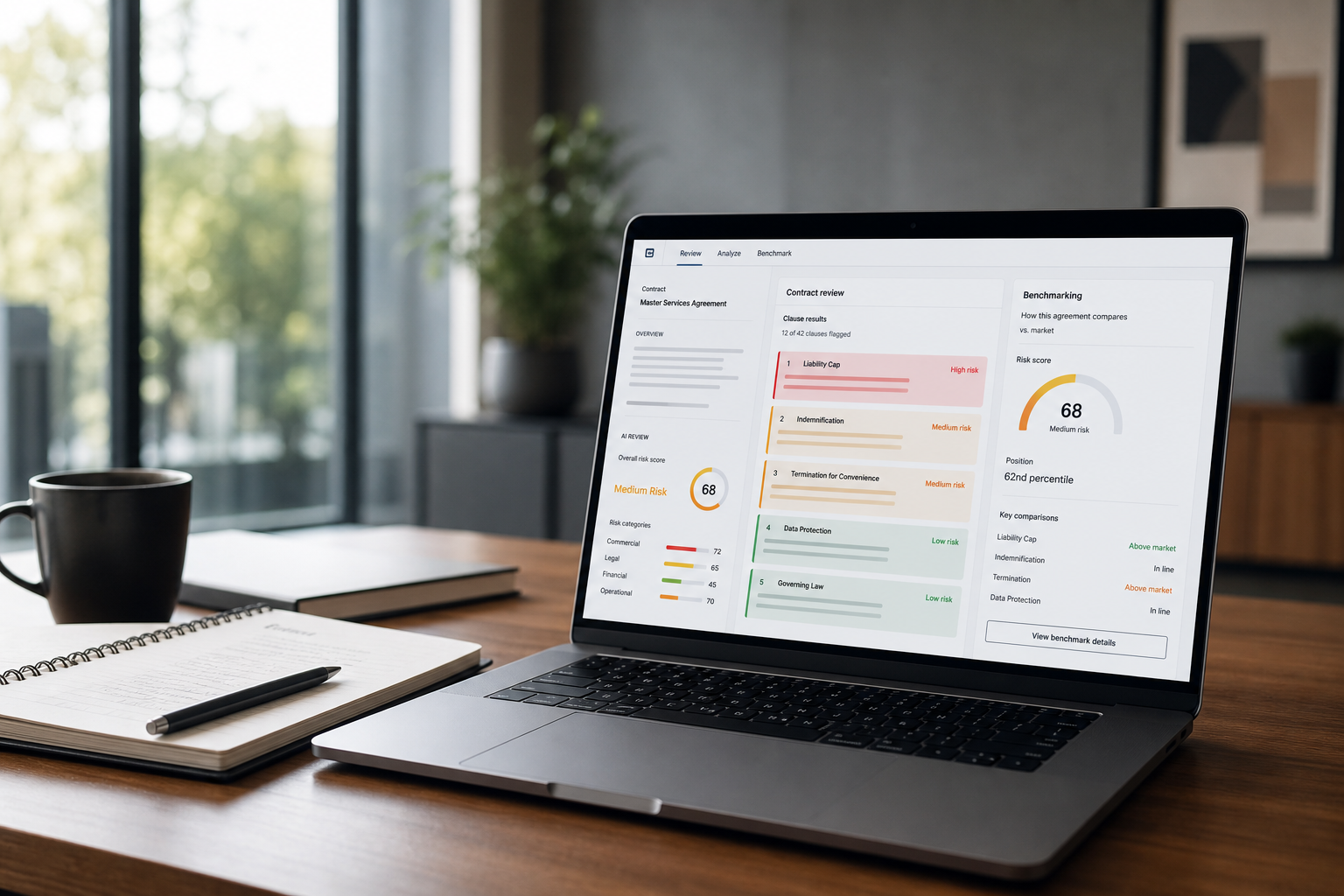
The software then scores or categorizes each clause against a set of benchmarks. Some platforms use internal playbooks. Others, like TermScout's Certify, benchmark clauses against thousands of real-world market agreements. This distinction matters because market-backed benchmarking gives you an objective view of whether a vendor's terms are standard or aggressive.
After analysis, the platform surfaces contract signals: risk flags, negotiation priorities, approval recommendations, and benchmarking comparisons. Your team can then decide whether to approve, negotiate, or escalate each agreement based on data rather than gut instinct.
Some platforms stop at extraction and classification. The most advanced tools also track changes over time and aggregate signals across your entire vendor portfolio, giving you a governance layer on top of individual agreement analysis.
Essential Evaluation Criteria for AI Contract Intelligence Software
Choosing the right platform requires a structured approach. Below are the criteria that matter most for enterprise procurement and legal teams.
How Transparent Is the Scoring Methodology?
Ask how the platform arrives at its risk scores and favorability ratings. A transparent methodology lets your legal team validate the AI's reasoning rather than trusting a black box. Platforms that explain which clauses triggered a score and why are far more useful in regulated environments.
TermScout addresses this directly by combining AI analysis with independent legal expert validation. Every contract signal is traceable to a specific clause and benchmarking standard, so your team can verify the output before acting on it.
Does the Platform Include Human Oversight?
AI performs well on structured extraction and classification tasks, but contract interpretation still requires human judgment. Look for platforms that pair AI analysis with attorney or legal expert review, especially for high-stakes agreements.
The combination of AI speed with human accountability is critical. Without oversight, automated outputs can miss context that changes the meaning of a provision. Professional legal review adds a layer of quality assurance that pure automation cannot replicate.
What Accuracy Metrics Does the Vendor Report?
Request specific performance data. Precision, recall, and F1 scores tell you how reliably the platform identifies clauses and flags risks. TermScout reports 99% contract signal accuracy, validated across thousands of agreements.
Avoid vendors that rely solely on marketing language like "AI-powered" without disclosing how their models perform on real contracts. Quantifiable accuracy metrics are the clearest indicator of whether a platform will deliver reliable results for your team.
How Does the Platform Handle Benchmarking?
Market benchmarking is what separates contract intelligence from basic extraction. A platform that only pulls data from your own templates cannot tell you whether a vendor's liability cap is standard for your industry.
Look for benchmarking against verified, real-world agreements. This approach reveals whether a vendor's terms fall inside market range, outside market range, or are materially aggressive. That context changes how your team negotiates.
What Integration Capabilities Does It Offer?
Your contract intelligence platform needs to fit into existing workflows. Check for integrations with your CRM, document management system, and procurement tools. TermScout integrates with systems like Salesforce and major procurement platforms, reducing manual data entry and keeping contract data connected to your deal pipeline.
Does It Support Portfolio-Level Visibility?
Individual contract analysis is a starting point. Enterprise teams also need portfolio-level views: how does a specific vendor's contract posture compare across multiple agreements? Where are risk concentrations building across your vendor base?
TermScout's Certify Profile aggregates contract signals across agreements to show vendor-level patterns, enabling side-by-side comparisons and consistent decision-making across your portfolio.
What Are the Core Capabilities to Look For?
When evaluating platforms, these capabilities should be on your checklist.
Clause-Level Extraction and Classification
The platform should identify and categorize individual clauses, not just flag entire documents. Clause-level granularity lets your team focus on the specific provisions that create risk or require negotiation.
Pay attention to how the platform handles non-standard clause structures. Agreements from different vendors use varying language for similar provisions. A strong AI engine recognizes equivalent clauses even when the wording differs.
Risk Scoring and Signal Generation
Look for structured risk signals that go beyond simple "high/medium/low" labels. The most useful platforms tell you which specific terms are creating risk, how they compare to market norms, and what action your team should take.
Effective risk scoring connects each signal to a specific clause in the agreement. Your legal team should be able to click through from a risk flag to the exact language that triggered it.
Contract Benchmarking Against Market Data
Market-backed benchmarking quantifies whether a vendor's terms are reasonable. This capability reduces subjective debate during negotiations and gives procurement a factual basis for pushback or approval.
Without benchmarking, every negotiation starts from scratch. Your team has no way to know whether a liability cap is standard or an outlier. Market data eliminates that uncertainty.
Change Detection and Monitoring
Vendor agreements evolve over time. A strong platform detects when contract terms shift after initial approval, alerting your team to new risks before they become problems. TermScout's Certify Monitor tracks meaningful contract changes and evolving risk signals over time.
This capability is especially important for large vendor portfolios where renewal terms may differ from the original agreement without clear notification.
Independent Certification
Independent, third-party certification adds a layer of trust that self-reported scores cannot match. TermScout's TrustMark certification verifies that a commercial contract meets recognized standards for fairness, transparency, and balanced legal terms.
Certified agreements have been shown to reduce redlines and speed approval cycles. For sales teams, a TrustMark badge gives buyers immediate confidence that the agreement has been independently validated.
Common Pitfalls When Evaluating AI Contract Intelligence Software
Enterprise buyers often make avoidable mistakes during the evaluation process. Here are the ones to watch for.
Confusing CLM Tools with Contract Intelligence
Contract management platforms manage workflows: routing, approvals, storage, and e-signatures. Contract intelligence platforms analyze agreements, benchmark terms, and generate decision-ready signals. These are different capabilities, and most organizations need both.
Do not assume that your existing CLM tool handles contract intelligence. Many CLM systems lack clause-level benchmarking and risk scoring entirely.
Overlooking the Black Box Problem
If a platform cannot explain how it arrived at a risk score, your legal team will not trust it. Opaque scoring undermines adoption and creates compliance risk in regulated industries.
Prioritize platforms that show their reasoning. TermScout's approach of combining AI analysis with human expert validation gives your team traceable, defensible outputs.
Ignoring Post-Signature Visibility
Many buyers focus exclusively on pre-signature analysis. But vendor terms can change at renewal, and risk concentrations shift as your vendor base grows. Make sure the platform you choose supports ongoing monitoring and portfolio-level governance.
Relying on Generic AI Tools for Legal Analysis
General-purpose AI tools can summarize text, but they are not trained on legal corpora and lack the domain-specific precision required for contract analysis. Research consistently shows that domain-adapted models outperform general-purpose baselines in clause extraction and legal classification tasks.
For enterprise contract decisions, you need a platform built specifically for legal and procurement workflows, not a general-purpose chatbot.
How to Build Your AI Contract Intelligence Evaluation Framework
A structured evaluation process helps your team compare platforms objectively. Follow these steps to build your framework.
Step 1: Define Your Use Cases
Start by identifying the specific problems you need to solve. Are you focused on intake triage? Vendor risk assessment? Negotiation support? Portfolio governance? Your use cases will determine which capabilities matter most.
Step 2: Establish Scoring Criteria
Create a weighted scorecard that covers transparency, accuracy, benchmarking depth, integration, security, and support. Weight each criterion based on your organization's priorities.
Step 3: Request Live Demonstrations with Your Own Contracts
Marketing demos use curated examples. Ask each vendor to analyze your actual agreements so you can evaluate performance on contracts that reflect your specific risk profile and industry.
Step 4: Verify Claims with Reference Customers
Ask for references from organizations similar to yours in size, industry, and contract volume. Confirm that the vendor's accuracy and support claims hold up in practice.
Step 5: Assess Total Cost of Ownership
Factor in implementation time, training requirements, ongoing support costs, and any per-contract or per-user fees. A platform that delivers faster ROI through reduced legal hours and shorter approval cycles often pays for itself quickly.
What Role Does AI Contract Intelligence Play in Vendor Risk Management?
Vendor risk assessment has traditionally relied on questionnaires, security ratings, and financial audits. Contract intelligence adds a missing layer: the actual terms governing your vendor relationships.
By analyzing contract language at scale, AI contract intelligence software reveals patterns that questionnaires cannot capture. Which vendors consistently include aggressive liability caps? Where are your termination rights weakest? Which agreements lack adequate data governance provisions?
This level of visibility turns contract data into a strategic asset for your procurement team. Instead of treating each agreement in isolation, you gain a portfolio view of vendor risk that supports smarter, faster decisions.
How AI Contract Intelligence Accelerates Deal Velocity
Long approval cycles hurt revenue. When every agreement requires full legal review, your sales pipeline slows and buyers lose confidence.
AI contract intelligence software speeds this process by triaging agreements at intake. Contracts that fall inside market norms can move forward quickly. Only agreements with genuine risk signals require full legal attention.
TermScout customers report that certified contracts reduce sales cycle times significantly, with some teams seeing up to 80% reduction in negotiation time. That acceleration comes from replacing uncertainty with structured, market-backed data that both sides can trust.
How AI-Specific Contract Risks Affect Your Evaluation
As more vendors incorporate AI into their products and services, new contract risks are emerging. Clauses governing AI data usage, model training on your proprietary information, and liability for AI-generated outputs are becoming standard negotiation points.
Your contract intelligence platform should be able to identify and flag these AI-specific provisions. TermScout's Certify AI analyzes AI-related contract terms and disclosure gaps, helping your team assess whether a vendor's AI practices meet your organization's requirements.
Ignoring AI-specific contract risks during procurement can expose your organization to data governance violations and unintended intellectual property transfers. As regulatory frameworks around AI continue to develop, having visibility into these terms becomes increasingly important.
How Security and Compliance Factor into Your Decision
Contracts often contain sensitive business information. Any platform that analyzes your agreements must meet enterprise security standards.
Look for SOC 2 certification, data encryption at rest and in transit, role-based access controls, and clear data retention policies. Ask vendors whether your contract data is used to train their AI models, and whether they offer data isolation options.
TermScout maintains an A+ security grade from Qualys SSL Labs and follows strict data governance practices. For regulated industries, these security credentials are a non-negotiable part of the evaluation process.
In Conclusion: Choosing the Right AI Contract Intelligence Software for Your Organization
The right AI contract intelligence platform does more than extract clauses. It gives your legal and procurement teams the structured data, market benchmarks, and risk signals they need to make confident decisions at scale.
Focus your evaluation on transparency, accuracy, benchmarking depth, and human oversight. Avoid platforms that operate as black boxes or lack market-backed scoring. Test with your own contracts, not curated demos.
TermScout's Certify platform is built for exactly this kind of enterprise decision-making, combining AI-powered contract analysis with independent legal expert validation and TrustMark certification. If your team is ready to turn contracts into deal-makers instead of bottlenecks, start by benchmarking your agreements with Certify.
FAQs about AI Contract Intelligence Software
What is the difference between contract intelligence and contract management software?
Contract management software handles workflows like routing, approvals, and storage. Contract intelligence software analyzes agreement terms, benchmarks them against market data, and generates risk signals. TermScout's Certify platform focuses on intelligence, delivering clause-level analysis and market benchmarking that workflow tools do not offer.
How accurate is AI at analyzing contract clauses?
Accuracy depends on the platform's training data and methodology. TermScout's Certify reports 99% contract signal accuracy, validated across thousands of real-world agreements. Always ask vendors for specific precision and recall metrics before committing.
Can AI contract intelligence software replace lawyers?
No. AI accelerates the analysis process and surfaces risks that might otherwise be missed, but legal judgment remains essential for interpretation and negotiation. TermScout combines AI analysis with human legal expert validation to ensure accuracy and accountability.
How does contract benchmarking work in practice?
The platform compares your vendor's contract terms against a database of real-world market agreements. TermScout's Certify benchmarks each clause to show whether it falls inside market range, outside market range, or is materially aggressive. This gives your team objective context for every negotiation.
What types of agreements can AI contract intelligence software analyze?
Most platforms handle common procurement agreement types including NDAs, data processing agreements, IT agreements, and service agreements. TermScout's Certify analyzes these agreement types and benchmarks them against market standards, so your team gets relevant comparisons regardless of contract type.
How long does it take to get results from AI contract analysis?
Processing times vary by platform, but AI-powered analysis typically delivers results in minutes rather than the hours or days required for manual assessment. TermScout's Certify generates contract signals and benchmarking data shortly after upload, enabling same-day intake decisions for your procurement team.

Gautam Joshi
Founding Growth Manager
Gautam Founding Growth Manager at TermScout leverages marketing expertise by combining data-driven brand strategy, messaging, demand generation, and sales enablement to boost revenue and streamline deals.
Share this

What Is Contract Certification for Vendor Risk Teams
The Complete Guide to Contract Clause Benchmarking