.png?width=130&height=53&name=Vector%20(21).png "TermScout Logo")

Contract review has traditionally been one of the most time-consuming activities across legal, procurement, sales, and finance teams.
Every agreement requires careful analysis. Teams must identify risks, evaluate obligations, compare terms, and determine whether contractual positions align with business objectives. As contract volume grows, manual review becomes increasingly difficult to scale.
The challenge is not simply reviewing contracts faster.
The challenge is understanding what contract terms mean, how they compare to market standards, and which provisions are most likely to create risk or negotiation friction.
That is why organizations are increasingly adopting automated contract review.
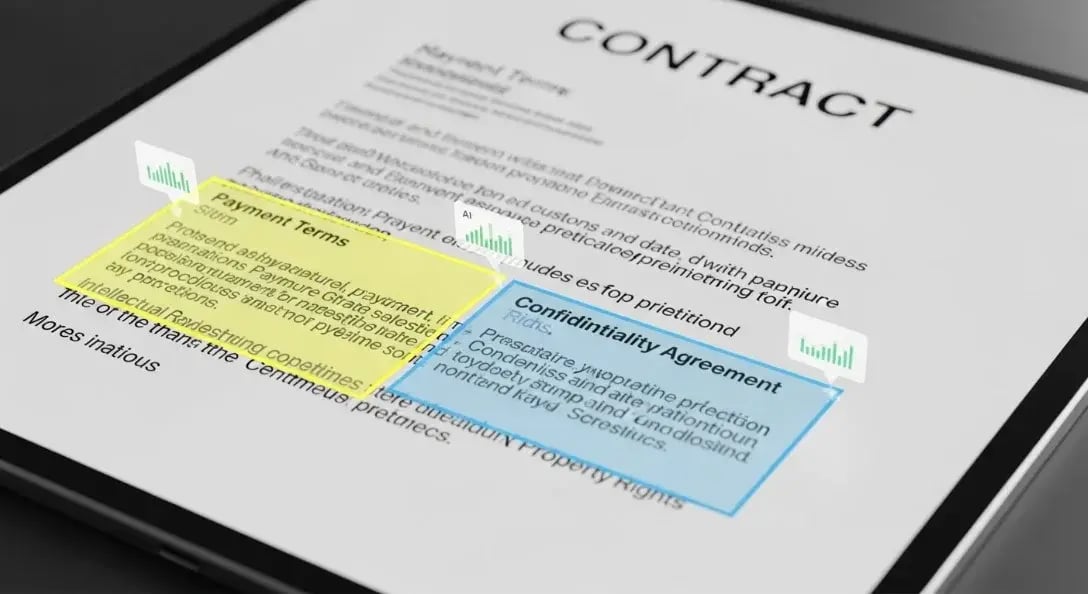
Automated contract review uses artificial intelligence to analyze contract language, identify risks, benchmark terms, surface contract signals, and support faster legal, procurement, and commercial decisions.
The most advanced platforms go beyond clause extraction by providing contract intelligence, market benchmarking, and procurement decision support.
Key Takeaway
The future of contract review is not automation alone. It is contract intelligence that helps organizations make better decisions.
Why Traditional Contract Review No Longer Scales
Manual contract review was designed for a world where contract volume was manageable and legal teams could evaluate agreements one document at a time.
Today, organizations face a different reality.
Legal, procurement, sales, and finance teams must manage:
- Growing contract volumes
- Faster deal cycles
- Increasing regulatory complexity
- Cross-functional approval requirements
- Expanding supplier ecosystems
Traditional review processes often create:
- Approval bottlenecks
- Longer contract cycles
- Inconsistent evaluations
- Escalation fatigue
- Limited visibility into market norms
The result is slower decision-making and increased operational friction.
Organizations need a more scalable approach.

What Is Automated Contract Review?
Automated contract review uses artificial intelligence, machine learning, and natural language processing to analyze contract language and identify important contractual provisions.
Modern platforms can:
- Extract key clauses
- Identify obligations
- Flag unusual terms
- Surface potential risks
- Compare contract versions
- Categorize contractual language
These capabilities significantly reduce the manual effort required to review agreements.
However, identifying clauses is only the first step.
The more valuable question is whether those clauses are fair, market-aligned, and likely to create negotiation friction.
That is where contract intelligence becomes essential.
Automated Contract Review vs Contract Intelligence
Many organizations assume automated review and contract intelligence are the same thing.
They are not.
| Capability | Automated Contract Review | Contract Intelligence |
|---|---|---|
| Clause Extraction | Yes | Yes |
| Obligation Identification | Yes | Yes |
| Risk Flagging | Yes | Yes |
| Market Benchmarking | Limited | Yes |
| Contract Signals | Limited | Yes |
| Procurement Decision Support | No | Yes |
| Market Alignment Analysis | No | Yes |
| Negotiation Intelligence | No | Yes |
Automated review explains what is in a contract.
Contract intelligence explains what it means.
That distinction is increasingly important as organizations seek better decisions rather than simply faster reviews.
Why Benchmarking Matters
A contract clause may appear reasonable in isolation.
The real question is how that clause compares to the market.
Contract benchmarking provides the context necessary to answer that question.
Benchmarking helps organizations determine:
- Whether terms are market-standard
- Which provisions are unusually aggressive
- Which clauses create negotiation friction
- Which positions are likely to require escalation
Without benchmarking, contract review remains largely subjective.
With benchmarking, organizations gain objective evidence that supports more consistent decisions.
Market Alignment Drives Faster Decisions
Market alignment measures how closely contract terms reflect accepted standards across comparable agreements.
Organizations that understand market alignment can:
- Reduce approval delays
- Improve negotiation outcomes
- Increase consistency
- Strengthen procurement reviews
- Improve stakeholder confidence
Benchmarking transforms contract review from document analysis into decision intelligence.
Every Contract Contains Signals
Contracts communicate more than legal obligations.
They also reveal signals about risk, trust, favorability, and approval likelihood.
Contract signals help organizations identify the issues most likely to affect outcomes.
Examples include:
| Contract Signal | What It May Reveal |
|---|---|
| Risk Signal | Elevated contractual exposure |
| Market Alignment Signal | Whether terms match market norms |
| Favorability Signal | Whether terms are balanced or one-sided |
| Escalation Signal | Likelihood of additional review |
| Trust Signal | Potential for smoother approvals |
Organizations that understand contract signals can prioritize reviews more effectively and focus resources where they create the greatest impact.
How Automated Contract Review Helps Different Teams
Legal Teams
Legal teams use automated review to identify non-standard provisions, prioritize high-risk agreements, and reduce manual review effort.
This enables attorneys to focus on strategy, negotiation, and risk management rather than repetitive document analysis.
Procurement Teams
Procurement teams increasingly rely on contract intelligence to evaluate supplier agreements before approval.
Procurement Decision Intelligence helps teams determine:
- Which agreements require escalation
- Which vendor terms differ from market standards
- Which contracts create operational risk
- Which suppliers present unusual contractual exposure
This supports faster and more consistent procurement decisions.
Finance Teams
Finance leaders use contract intelligence to evaluate:
- Revenue commitments
- Liability exposure
- Contract-driven financial risks
- Forecasting assumptions
- Renewal obligations
This improves financial planning and risk visibility.
Sales Teams
Sales organizations benefit from faster approvals and fewer contract delays.
Contract intelligence helps identify the clauses most likely to slow negotiations and impact deal velocity.
From Contract Automation to Contract Intelligence
The first generation of contract automation focused on efficiency.
The next generation focuses on decision quality.
Organizations increasingly need answers to questions such as:
- Is this agreement market-aligned?
- Which terms create negotiation friction?
- Which clauses are likely to delay approval?
- How does this contract compare to similar agreements?
- Which risks deserve attention?
These questions cannot be answered through clause extraction alone.
They require contract intelligence.
How Certify™ Enhances Automated Contract Review
Most automated review platforms identify contract language.
Certify™ helps organizations understand what that language means.
Using AI-powered contract analysis, Certify™ benchmarks contractual terms against comparable agreements and evaluates:
- Market alignment
- Favorability
- Risk exposure
- Contract quality
- Negotiation complexity
- Trust readiness
Rather than reviewing contracts in isolation, organizations gain visibility into how agreements compare to broader market standards.
Benefits include:
- Faster contract reviews
- Better consistency
- Stronger procurement decisions
- Reduced negotiation friction
- Improved approval speed
Certify™ transforms contract review into contract intelligence.
TrustMark™: Making Contract Quality Visible
Internal analysis helps organizations make better decisions.
TrustMark™ helps communicate those insights externally.
TrustMark™ serves as a visible trust signal that demonstrates contractual terms have been independently evaluated and benchmarked against market standards.
This helps:
- Increase buyer confidence
- Reduce procurement friction
- Improve transparency
- Accelerate approvals
- Shorten contract cycles
TrustMark™ turns contract intelligence into a competitive advantage.
The Future of Automated Contract Review
Automated contract review is evolving rapidly.
Organizations are moving beyond basic document analysis and toward:
- Contract Intelligence
- Contract Benchmarking
- Contract Signals
- Procurement Decision Intelligence
- Market Alignment Analysis
- Contract Certification
The future belongs to organizations that can transform contracts into actionable business intelligence.
The objective is no longer simply reading contracts faster.
The objective is making better decisions.
Frequently Asked Questions
What is automated contract review?
Automated contract review uses AI to analyze contract language, identify clauses, flag risks, and support faster contract evaluation.
How does automated contract review work?
The technology uses machine learning and natural language processing to identify contractual provisions, obligations, risks, and key terms within agreements.
What is the difference between automated contract review and contract intelligence?
Automated review identifies and categorizes contract language. Contract intelligence adds benchmarking, market comparison, contract signals, and decision support.
Can AI benchmark contract terms?
Yes. Advanced contract intelligence platforms compare contractual provisions against market data to determine whether terms are standard, favorable, risky, or unusual.
How do procurement teams use contract intelligence?
Procurement teams evaluate supplier agreements, identify risk, compare terms to market standards, and determine which contracts require escalation.
Does automated contract review replace lawyers?
No. Automated review supports legal professionals by reducing manual analysis and surfacing insights. Lawyers remain essential for strategy, judgment, negotiation, and risk management.
Move Beyond Automation to Contract Intelligence
Automated contract review is valuable.
Contract intelligence is transformative.
Organizations that rely solely on clause extraction will continue to spend time debating contractual positions without market context.
Organizations that combine AI, benchmarking, contract signals, and procurement intelligence gain a clearer understanding of risk, favorability, and negotiation outcomes.
That visibility leads to faster approvals, stronger decisions, and more efficient contract management.
See How Your Contracts Compare to the Market
Request a Certify™ analysis to benchmark your agreements, identify contract signals, and understand which terms may create risk, negotiation friction, or approval delays.
See how Certify™ transforms automated contract review into market-backed contract intelligence that helps legal, procurement, finance, and sales teams make faster and more confident decisions.
Share this

Contract Analytics and Contract Intelligence: How AI Transforms Contracts from Risk to Revenue
.jpg)
Contract Revenue Recognition: How Contract Intelligence Improves Forecast Accuracy