.png?width=130&height=53&name=Vector%20(21).png "TermScout Logo")

Contract certification isn't about slapping a logo on a document and calling it verified. The process demands methodical analysis, industry benchmarking, and transparency about what the data actually shows. When a company earns the TermScout Certify™ badge, that seal represents hours of AI-driven contract intelligence combined with human legal validation—not just automated scoring that skips the nuance.
The market has been flooded with tools that promise to simplify contracts, but most stop at surface-level analysis. Real contract certification requires digging into clauses, comparing them against thousands of verified agreements, and making judgment calls when the data doesn't give a clean answer. That's where the methodology matters.
Decoding the Real Work Behind Contract Verification
At its core, contract certification evaluates whether an agreement treats both parties reasonably. The goal isn't to determine which side "wins"—that adversarial framing misses the point. Instead, the certification contract process identifies whether terms fall within acceptable market standards or tilt so heavily in one direction that they create friction.
TermScout's system analyzes each clause and assigns a favorability rating. These ratings emerge from comparing the language against real-world contract data across industries. When a clause shows up as "Balanced," that means the majority of similar agreements in the database contain comparable language.
-1.webp?width=654&height=213&name=image2%20(1)-1.webp)
The certification process focuses on eliminating deal-breakers—clauses so one-sided they consistently cause negotiations to stall. Legal teams know these culprits well:
- Unlimited liability provisions that expose companies to catastrophic risk
- Perpetual auto-renewals without reasonable escape clauses
- Indemnification terms that shift unreasonable risk to one party
- Unilateral amendment rights that let vendors change terms without consent
A certification contract must contain zero deal-breaker clauses to earn the badge. Not one. Not "mostly clean with a couple of exceptions." Zero.
When "Answer Varies" Actually Tells You Something Useful
Here's where the methodology gets interesting. Not every clause fits neatly into a rating bucket. Sometimes the data shows genuine variation across industries, company sizes, or deal types. Rather than force a rating that doesn't reflect reality, TermScout's system returns "Answer Varies."
This might sound like a cop-out, but it's actually more honest than pretending certainty exists where it doesn't. Consider non-compete clauses in SaaS agreements. In some sectors, broad non-competes are standard. In others, they're virtually nonexistent.
When procurement teams review a contract and see "Answer Varies" on specific terms, they're getting information worth having. It signals: this is a clause worth discussing with your legal team, not because it's necessarily problematic, but because industry norms genuinely differ here.
The Machinery Behind the Magic: AI Meets Human Expertise

The technical foundation of contract certification starts with AI-powered contract intelligence that can parse legal language. Not just read it—actually understand clause relationships, identify edge cases, and flag language that deviates from standard patterns.
TermScout's system ingests thousands of real contracts from completed B2B deals. These aren't theoretical templates or law school examples. They're actual agreements that companies negotiated, signed, and used to conduct business.
The AI extracts key data points from each clause: liability caps, termination rights, payment terms, renewal structures, warranty limitations, and dozens of other provisions. Each data point gets coded and compared against the broader data set. Statistical patterns emerge. Outliers become visible.
But here's the thing—contract language is slippery. Two clauses can say functionally identical things using completely different words. Or they might use similar words while creating vastly different obligations. The AI handles this through sophisticated language modeling trained specifically on legal text.
Why Lawyers Still Matter in the Process
AI analysis handles scale, but human legal experts provide the quality assurance that makes contract certification credible. Every contract analyzed by TermScout's system goes through review by attorneys who understand how clauses actually operate in practice.
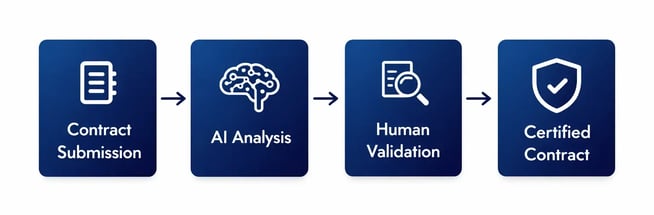
These reviewers catch things algorithms miss. Maybe the AI correctly identified a liability cap but missed that another clause effectively renders it meaningless. Perhaps a termination clause looks customer-favorable on its surface, but contains buried language that complicates exit timing.
The validation layer also handles context the AI can't fully grasp. A clause might technically fall outside market norms but make perfect sense for the specific business model or industry segment. The reviewers can flag these situations and provide notes explaining why the deviation isn't actually problematic.
|
Analysis Stage |
Primary Function |
What It Catches |
|
AI Extraction |
Identifies and categorizes clauses |
Pattern deviations, standard provisions, key terms |
|
AI Comparison |
Benchmarks against database |
Statistical outliers, market positioning |
|
Human Review |
Validates AI findings |
Contextual nuances, clause interactions, industry-specific considerations |
|
Final Certification |
Determines badge eligibility |
Deal-breakers, overall favorability balance |
Breaking Down the Rating System Without the Jargon
The certification contract uses a straightforward rating structure: Customer-Favorable, Balanced, and Vendor-Favorable. These categories aren't subjective opinions. They reflect statistical analysis of where specific terms fall relative to thousands of comparable agreements.
Customer-Favorable terms benefit the buyer more than typical market standards. These might include longer payment terms than average, stronger service level commitments, or more flexible termination rights. Contracts with predominantly customer-favorable terms often move through procurement faster because legal teams see fewer negotiation triggers.
Balanced terms are split fairly between parties. The vendor gets reasonable protections and the customer receives standard safeguards. Most certified contracts fall primarily in this category—not because compromise is automatically ideal, but because balanced agreements tend to close faster with less friction.
Vendor-Favorable terms tilt toward the seller, though contracts with too many of these clauses won't qualify for certification. Why? Because heavily vendor-favorable agreements consistently create negotiation delays that slow revenue recognition.
Getting from Analysis to Approval: The Certification Decision
The TermScout Certify™ badge requires passing a bright-line test: the contract must contain zero deal-breaker clauses. This standard doesn't bend. Even one egregious provision disqualifies the agreement, regardless of how favorable the rest of the terms appear.
What constitutes a deal-breaker? Clauses that legal counsel consistently redline across industries and company types. The zero-tolerance policy might seem harsh, but it serves a purpose. When buyers see the certification badge, they need confidence that the contract won't contain landmines requiring extensive negotiation.
What Earning the Badge Really Means
Contracts that achieve either Balanced or Customer-Favorable overall ratings and contain zero deal-breakers qualify for the TermScout Certify™ badge. This badge isn't a decoration. It functions as proof that an independent third party verified the contract meets market standards for fair terms.
The certification contract report accompanies the badge, providing detailed breakdowns of how each major clause rated. This transparency lets legal teams spot-check the analysis if they want validation. Most don't bother—the fact that the methodology is auditable builds sufficient trust.
Why Being Honest About Limitations Builds Trust
The contract certification process earns credibility by being honest about what it can and cannot determine. When the data supports clear conclusions, the system states them directly. When genuine ambiguity exists, it says so rather than manufacturing false precision.
This approach contrasts sharply with black-box scoring systems that generate numbers without explaining their reasoning. Buyers and legal teams are sophisticated enough to spot when an algorithm is overselling its certainty.
Consider a scenario where a specific clause type appears in only a small percentage of similar contracts in the database. Is that clause an outlier that should raise red flags, or is it an emerging best practice that hasn't yet become standard? The honest answer might be: we don't have enough data to say definitively. Acknowledging that gap is more valuable than pretending confidence.
The Business Case Nobody Talks About
Contract certification exists to solve a specific problem: procurement bottlenecks that delay revenue recognition. When buyers receive vendor agreements, their legal teams must review every clause, research market standards, and negotiate changes. This process can stretch for weeks or months.
Certified contracts short-circuit this cycle. Legal counsel can verify the certification badge, review the accompanying report, and approve the agreement much faster. The independent validation provides cover for procurement teams who might otherwise face internal pressure to negotiate extensively regardless of actual contract quality.
Who Actually Benefits and How
-1.webp?width=654&height=433&name=image3%20(1)-1.webp)
For Sales Teams: Proof That Ends the Stalemate
Sales teams struggle with procurement delays that have nothing to do with pricing or product fit. Legal reviews stall deals. Redlines multiply through endless iteration. Decision-makers lose enthusiasm while waiting for contract approval.
The certification badge changes this dynamic by providing immediate proof that terms meet market standards. When sales reps share certified contracts, they're not just claiming the agreement is fair—they're backing that claim with independent verification.
Key advantages for sales include:
- Shorter time-to-close for deals stuck in legal review
- Stronger negotiating position when procurement requests changes
- Reduced back-and-forth on standard provisions
- Faster revenue recognition and improved forecast accuracy
For Legal Departments: Reclaiming Time for Complex Work
Corporate legal departments operate perpetually understaffed relative to the volume of contracts requiring review. Every vendor agreement competes for limited attorney attention. Most of these reviews involve checking the same provisions against the same standards repeatedly.
Contract certification eliminates this redundant work for certified agreements. When legal counsel receives a contract with the TermScout badge, they can skip straight to the certification report, review the clause-level ratings, and approve the deal—or focus their time on the few provisions that require closer attention.
This efficiency gain lets legal teams redirect attention to truly complex agreements that demand specialized expertise. The certification doesn't replace legal judgment; it provides validated inputs that support faster, more confident decisions.
For Procurement: Numbers That Actually Mean Something
Procurement professionals constantly negotiate with vendors who claim their contracts offer "market-standard terms" or "customer-friendly provisions." These claims are difficult to verify without extensive research into comparable agreements—research that procurement teams rarely have time to conduct thoroughly.
|
Without Certification |
With Certification |
|
Vendor claims cannot be verified |
Independent validation confirms claims |
|
Each contract requires full legal review |
Pre-vetted contracts accelerate approval |
|
Unclear negotiating position |
Objective benchmarking supports decisions |
|
Difficult to justify choices internally |
Certification provides auditable documentation |
Independent contract certification solves this verification problem by providing objective benchmarking backed by real data. When a vendor presents certified terms, procurement knows those claims have been validated against thousands of actual agreements.
The certification also helps procurement teams justify decisions internally. Choosing a vendor with certified customer-favorable terms creates an auditable paper trail showing the agreement met fairness standards.
When Certification Makes Sense (And When It Doesn't)
Honesty requires acknowledging situations where contract certification doesn't add much value. Highly customized deals with extensive negotiations won't benefit from standardized certification—the uniqueness is the point. Agreements between long-standing partners with established trust don't need third-party validation.
The sweet spot for contract certification involves mid-market to enterprise B2B deals where procurement processes exist but aren't so bureaucratic that certification can't streamline them. SaaS agreements, professional services contracts, and vendor relationships with substantial annual contract values tend to benefit most.
Recognizing these boundaries matters. Contract certification solves specific problems exceptionally well. Overselling it as a universal solution would undermine the credibility that makes it valuable in the right contexts.

A Different Path to Standardization
The traditional approach to contract efficiency involves creating "customer-friendly" templates that still protect vendor interests. But templates only work when both parties agree to use them—and sophisticated buyers often insist on their own paper. That leads to template warfare that benefits neither side.
Contract certification offers an alternative path. Instead of fighting over whose template to use, vendors can certify their standard agreements and demonstrate that the terms meet market fairness standards. Buyers get validation without imposing their templates. Vendors maintain control over their preferred language.
This approach preserves room for differentiation while establishing a baseline of fair terms. Companies can still compete on contract quality—offering better payment terms, stronger SLAs, or more flexible termination rights than competitors. The certification just proves those terms actually deliver on their promises.
Wrapping Up: What the Badge Really Represents
Contract certification works because the methodology behind it is honest, transparent, and focused on solving real problems. The badge means something because the analysis actually happened—AI extracted the clauses, humans validated the findings, and the contract met specific standards for fair terms and zero deal-breakers.
Understanding what goes into certification helps buyers trust the badge and vendors leverage it effectively. The process isn't perfect, and it doesn't pretend to be. When the data varies, it says so. When deal-breakers appear, the contract doesn't qualify. That straightforward approach builds the credibility that makes certified contracts valuable tools for accelerating B2B deals.
The market needs more transparency in how contracts get evaluated, not less. Contract certification delivers that transparency by showing the work, admitting limitations, and providing validation that legal, procurement, and sales teams can actually use to close deals faster.
Share this
.jpg)
What Is Contract Certification? How Independent Certification Builds Trust and Accelerates Deals

Fair Contract Certification in Vendor Risk Management
-3.webp)