Contracts influence revenue, risk, supplier relationships, compliance obligations, and operational performance. Yet many organizations still rely on manual review processes that create delays, overwhelm legal teams, and leave business stakeholders without the information they need to make confident decisions.
The challenge is not simply reviewing contracts faster. It is reviewing contracts more intelligently.
Modern contract review processes increasingly combine contract intelligence, benchmarking, and market comparison data to help teams understand whether terms are fair, balanced, and aligned with market standards before agreements are signed.
A contract review process is the systematic evaluation of legal, financial, operational, and commercial terms before signing an agreement. Modern teams use contract intelligence, benchmarking, and market comparison data to identify risks, assess fairness, and accelerate decisions.
What Are Contract Signals?
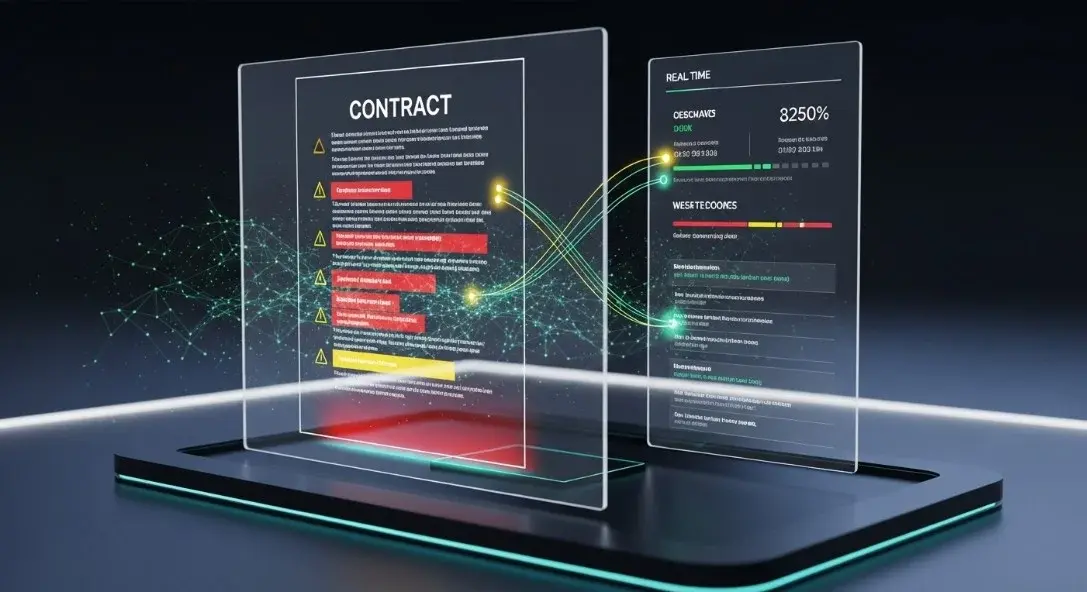
Contract signals are measurable indicators within agreements that reveal risk, fairness, market alignment, and negotiation likelihood.
Rather than reviewing every provision equally, organizations can use contract signals to identify the clauses most likely to create risk, negotiation friction, procurement concerns, or approval delays.
What Is a Contract Review Process?
A contract review process is a structured approach for evaluating agreements before execution.
The objective is not simply legal compliance.
Effective contract review helps organizations understand:
- Risk exposure
- Commercial impact
- Financial obligations
- Operational commitments
- Negotiation complexity
- Market alignment
In modern organizations, contract review is increasingly becoming a strategic business function rather than a purely legal activity.
Companies lose significant revenue through poor contract management, missed obligations, unfavorable terms, and inefficient review processes. Improving review quality helps reduce those risks while accelerating business outcomes.
Key Takeaway
The best contract reviews do not focus only on legal language. They evaluate contract signals, market alignment, financial impact, and negotiation risk.
Let’s make this concrete with a real scenario.
Why Traditional Contract Review Falls Short
Many organizations still rely on manual reviews that create bottlenecks across legal, procurement, finance, and sales teams.
Common challenges include:
- Inconsistent review standards
- Limited visibility into market norms
- Slow approval cycles
- Excessive legal escalation
- Lack of benchmarking data
- Difficulty prioritizing risk
The result is a process that identifies issues but often lacks the context needed to determine whether those issues actually matter.
The more valuable question is not:
"What does the contract say?"
The more valuable question is:
"How do these terms compare to market standards?"
That is where contract intelligence creates value.
Who Should Be Involved in Contract Review?
Effective contract review requires collaboration across multiple stakeholders.
Legal Teams
Evaluate legal exposure, compliance requirements, liability allocation, and enforceability.
Procurement Teams
Review supplier agreements, identify vendor risks, and assess whether contractual positions align with procurement objectives.
Procurement teams increasingly rely on contract intelligence to evaluate supplier risk before legal review begins.
Recommended Internal Link: Procurement Intelligence
Sales Teams
Assess customer-facing terms that may affect deal velocity and negotiation outcomes.
Finance Teams
Evaluate payment obligations, revenue implications, liability exposure, and renewal commitments.
Revenue Operations and Business Operations
Validate operational commitments, delivery obligations, and contract performance requirements.
Contract Review Framework
Before reviewing specific clauses, organizations should evaluate contracts across five core dimensions.
| Review Area |
Questions to Ask |
| Risk |
Does this clause create disproportionate liability? |
| Market Alignment |
Is this term typical for similar agreements? |
| Financial Impact |
Could this term affect revenue or cost? |
| Operational Impact |
Can we realistically comply with the obligation? |
| Negotiation Risk |
Will this term create friction during negotiations? |
This framework helps teams focus on business outcomes rather than legal language alone.
Contract Review Checklist
1. Review High-Risk Clauses First
Focus on provisions that create the greatest business exposure.
Examples include:
- Indemnification
- Limitation of liability
- Governing law
- Confidentiality
- Data security
- Termination rights
These clauses often drive the most significant negotiation discussions and risk allocation decisions.
2. Evaluate Market Alignment
A clause may appear reasonable but still be significantly outside market norms.
Contract benchmarking helps determine whether terms are:
- Customer Favorable
- Vendor Favorable
- Balanced
- Unusually restrictive
Market comparison data shows whether a clause is customer favorable, vendor favorable, balanced, or unusually restrictive.
Organizations that understand market alignment can negotiate more effectively and avoid unnecessary friction.
3. Eliminate Ambiguity
Ambiguous language creates disputes.
Review contracts for vague obligations, undefined terminology, and unclear performance requirements.
The clearer the language, the lower the likelihood of future disagreements.
4. Review Termination and Renewal Rights
Termination rights often determine the long-term flexibility of a business relationship.
Pay particular attention to:
- Auto-renewal provisions
- Termination for convenience
- Termination for cause
- Notice requirements
- Renewal windows
These provisions frequently affect operational flexibility and vendor management.
5. Assess Financial Impact
Contracts often contain hidden financial exposure.
Review:
- Payment obligations
- Pricing structures
- Service credits
- Penalties
- Revenue commitments
- Cost escalation mechanisms
Finance teams should understand how contractual commitments may affect profitability and forecasting.
6. Evaluate Risk Allocation
Risk allocation is often the most negotiated area of a contract.
Review whether responsibilities are distributed fairly across:
- Liability
- Indemnification
- Warranties
- Security obligations
- Compliance requirements
Unbalanced risk allocation frequently creates negotiation friction and approval delays.
7. Review Exhibits, Attachments, and Statements of Work
Important obligations often appear outside the main agreement.
Review:
- Statements of Work (SOWs)
- Pricing schedules
- Security exhibits
- Data processing agreements
- Service level agreements
These documents frequently contain operational and commercial commitments that affect contract performance.
8. Understand Remedies and Enforcement Rights
If a breach occurs, the contract should clearly define available remedies.
Review:
- Cure periods
- Damage limitations
- Escalation procedures
- Dispute resolution mechanisms
These provisions determine how issues are resolved when expectations are not met.
9. Use Contract Benchmarking Before Negotiation
Benchmarking is one of the most effective ways to improve contract review quality.
Rather than relying on assumptions, teams can compare terms against thousands of comparable agreements to understand:
- Market norms
- Negotiation risk
- Favorability
- Contract signals
- Likely acceptance rates
Benchmarking transforms contract review from opinion-based analysis into evidence-based decision-making.
How Contract Intelligence Improves Contract Review
Traditional review focuses on reading contracts.
Contract intelligence transforms legal language into structured business data that supports decision-making.
Instead of asking reviewers to interpret every provision manually, contract intelligence identifies patterns, benchmarks terms, and highlights areas requiring attention.
This allows organizations to focus resources where they create the greatest impact.
Benefits include:
- Faster reviews
- Better consistency
- Reduced legal bottlenecks
- Stronger procurement decisions
- Improved negotiation outcomes
- Greater visibility into contract risk
Recommended Internal Link: Contract Intelligence
How Certify™ Supports Modern Contract Review
Certify™ identifies contract signals across key clauses and benchmarks them against comparable agreements.
Rather than relying solely on manual interpretation, teams receive structured insights about:
- Market alignment
- Favorability
- Risk exposure
- Negotiation friction
- Potential deal breakers
- Contract quality
Certify™ helps procurement, legal, finance, and sales teams make decisions using contract intelligence instead of manual interpretation.
Whether you're reviewing supplier agreements, customer contracts, SaaS subscriptions, or enterprise MSAs, Certify™ helps stakeholders understand what terms mean in the context of the broader market.
Contract Intelligence + Benchmarking
With Certify™, teams can:
- Benchmark terms against market standards
- Identify contract signals
- Detect negotiation risks
- Understand favorability
- Prioritize legal review
- Improve decision quality
The result is a faster and more scalable contract review process.
Recommended Internal Link: Certify™
Empower Every Stakeholder to Review Contracts More Effectively
Modern contract review is not solely a legal function.
It is a business capability.
When organizations combine contract intelligence, benchmarking, and contract signals, every stakeholder gains access to actionable insights.
Procurement
Instantly identify supplier terms that may require escalation.
Sales
Understand which clauses are likely to slow negotiations.
Legal
Prioritize the provisions that create meaningful risk.
Finance
Identify financial exposure hidden within contractual commitments.
Operations
Track obligations before they become performance issues.
This shared visibility reduces bottlenecks and improves decision-making across the organization.
Frequently Asked Questions
What is a contract review checklist?
A contract review checklist is a structured framework used to evaluate legal, financial, operational, and commercial contract terms before signing.
What clauses should be reviewed first?
Most teams begin with indemnification, limitation of liability, termination rights, confidentiality, payment terms, and service levels.
How does contract benchmarking improve contract review?
Benchmarking compares contract terms against market standards, helping teams identify unusual risks, negotiation friction, and non-standard positions.
Can AI review contracts?
AI can identify clauses, benchmark terms, surface risks, and provide contract intelligence, allowing teams to review contracts more efficiently.
What is contract intelligence?
Contract intelligence transforms contract language into structured business insights that support legal, procurement, finance, and commercial decision-making.
What are contract signals?
Contract signals are measurable indicators that reveal risk, fairness, market alignment, and likely negotiation outcomes within agreements.
Move Beyond Contract Review to Contract Intelligence
The most effective contract review processes do more than identify issues.
They provide context.
Organizations that combine contract intelligence, benchmarking, and market comparison data gain a clearer understanding of risk, favorability, negotiation complexity, and market alignment before agreements are signed.
That visibility helps teams make faster and more confident decisions.
Want to Know Whether Your Contract Is Market-Aligned Before You Sign?
Upload a contract and receive a Certify™ analysis that benchmarks your terms against the market, identifies contract signals, highlights negotiation risks, and shows whether your agreement is Customer Favorable, Vendor Favorable, or Balanced.
See how your contract compares to market standards before negotiations slow down, risk increases, or opportunities are missed. TrustMark™ can then help demonstrate that commitment to transparency and market alignment after certification.
.png?width=130&height=53&name=Vector%20(21).png "TermScout Logo")

-1.jpg?width=2240&height=1260&name=Untitled%20design%20(1)-1.jpg)