.png?width=130&height=53&name=Vector%20(21).png "TermScout Logo")

There's a moment every procurement professional knows well. The vendor contract lands in the inbox. It's about 47 pages long, legal is backed up, and the business unit is already asking when they can start. Someone makes a call — not because the terms were properly evaluated, but because no one had the time or the tools to do it right.
That's not a personal failure. That's a structural one. And it's happening across procurement teams every single day.
The Real Efficiency Problem Nobody Wants to Admit
Procurement leaders talk a lot about speed. Faster approvals, shorter cycle times, fewer escalations. But speed without structure is just a faster way to make uninformed decisions. The root issue isn't process — it's information. Specifically, the lack of reliable data to evaluate what's in a contract before it gets signed.
When "Feels Right" Becomes the Default Standard
Post-mortems in procurement almost always focus on price. Did the team negotiate a discount? Did they hit savings targets? These are visible wins, easy to report. But the actual terms sitting beneath the pricing line often go unexamined — and that's where real exposure builds.
Here's what slips through without contract benchmarking:
- Liability caps set well below what the market considers reasonable
- Indemnification clauses that tilt almost entirely in the vendor's favor
- Auto-renewal provisions buried deep in the exhibits
- Termination restrictions that quietly lock the organization in for years
None of these are unusual. They show up routinely, and most procurement teams have no fast, reliable way to catch them — let alone compare them to what's actually standard in the market.
The "Standard" Myth
Vendors describe their terms as "standard" more often than the terms actually are. It's not always deliberate — sometimes it's just how their legal team talks. But without contract term benchmarking methods to check against real market data, there's no way to push back. The vendor says it's a market. The buyer has nothing to contradict it. The contract gets signed.
Contract benchmarking closes that gap. It moves the conversation from "does this feel fair?" to "how does this specific provision compare to what comparable organizations are actually agreeing to?" That shift alone changes how procurement handles vendor negotiations.
What Benchmarking Looks Like When It Actually Works
Contract benchmarking isn't abstract. It produces specific, structured data points about specific contract terms — and those data points change what procurement teams are able to do in a review.
The section below gets into the practical side: what a benchmark comparison actually surfaces, and how that intelligence flows into faster, more defensible decisions.
Standard vs. Outlier — Seeing the Difference Clearly
Consider two IT service agreements, both described as "standard" during vendor discussions.
|
Provision |
Standard Contract |
Outlier Contract |
|
Liability Cap |
2× annual fees |
Fees paid in prior 30 days only |
|
Indemnification |
Mutual |
Vendor-favored, unilateral |
|
Termination Notice |
30-day cure period |
90-day notice required |
|
Auto-Renewal Window |
30–60 days before end date |
120 days before end date |
Individually, any one of these provisions might slip through a manual review without a flag. Together, they represent a contract that's meaningfully imbalanced — and one that contract benchmarking would surface immediately, before the signature conversation even starts.
How Certify Procurement Turns Data Into Decisions
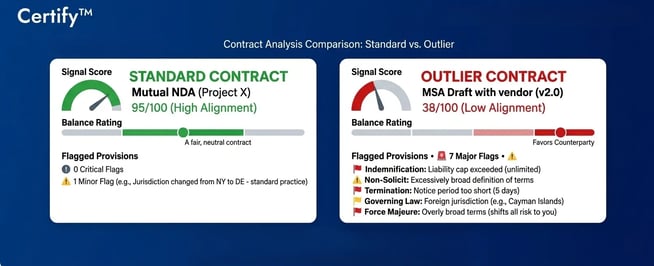
TermScout's Certify Procurement platform is built around exactly this kind of structured comparison. When a vendor agreement gets uploaded, Certify analyzes it and generates contract signals — clear, actionable data points that score the contract for balance, flag deal breakers, and compare specific provisions against real market agreements.
What that looks like in practice:
- Intake triage: Agreements are evaluated immediately, so procurement knows which contracts need attention and which can move forward
- Benchmark comparison: Each provision is scored against actual market data — not internal playbooks or assumptions
- Deal breaker identification: Clauses that commonly create friction or compliance concerns get surfaced automatically
- Risk visibility: The overall contract balance is scored so procurement can prioritize escalation accurately
The result is a review process that's faster not because steps are skipped, but because the right information is available at the right moment.
-Mar-26-2026-11-03-25-4627-AM.webp?width=654&height=387&name=image2%20(1)-Mar-26-2026-11-03-25-4627-AM.webp)
Less Noise, More Signal for Legal Teams
One of the most persistent inefficiencies in procurement is unnecessary legal escalation — routing every vendor agreement to legal regardless of actual risk level. When procurement teams don't have structured contract intelligence, everything feels like it might need a legal eye. So everything gets sent over.
Certify changes that dynamic. When procurement has access to clear contract signals and benchmark data, they can resolve routine agreements without pulling in legal resources that aren't needed. Legal attention gets focused on contracts that genuinely require it, not distributed equally across every agreement in the queue.
Making Benchmarking the Default, Not the Exception
Most procurement teams apply rigorous evaluation selectively — high-value deals, contracts that get flagged by someone paying attention, agreements that happen to land on the right reviewer's desk. Everything else moves through on instinct and institutional habit.
That selective approach is exactly where risk accumulates. The contracts that don't get scrutinized are often the ones where problematic terms go unnoticed the longest.
What Consistent Contract Benchmarking Actually Gives You
When contract benchmarking becomes a standard part of intake — not a one-off exercise for big deals — procurement teams build something they rarely have: a reliable, portfolio-wide view of what they've agreed to.
That view makes several things possible that aren't possible without it:
|
Capability |
Without Benchmarking |
With Benchmarking |
|
Reviewer consistency |
Depends on individual judgment |
Shared standards across the team |
|
Escalation decisions |
Based on instinct or workload |
Based on actual contract signals |
|
Vendor governance |
Reactive, after issues emerge |
Proactive, based on contract data |
|
Portfolio visibility |
Limited or nonexistent |
Structured, monitored over time |
Consistency matters here for more than governance reasons. When different reviewers apply different intuitions — different tolerances for the same risk, different instincts about what's normal — the outcomes across the portfolio become inconsistent. One reviewer escalates a term that another would approve without hesitation. Neither is necessarily wrong. Both are just working without a shared benchmark.
The Quiet Problem With "It's Always Worked Before"
There's a version of procurement risk that doesn't show up immediately. A contract with an aggressive auto-renewal window gets signed. Nobody notices until 14 months later when the renewal kicks in and the business unit didn't want to renew. A liability cap that seemed reasonable turns out to be far below market when a service failure actually happens and there's less coverage than expected.
-Mar-26-2026-11-04-33-6972-AM.webp?width=654&height=365&name=image3%20(1)-Mar-26-2026-11-04-33-6972-AM.webp)
This is what makes contract term benchmarking methods more than an intake tool — they're a governance mechanism. When terms are scored against real market data at the point of intake, that information becomes part of the organization's institutional knowledge about the vendor relationship. It can be monitored over time, referenced during renewals, and used to build a clearer picture of the full vendor portfolio.
The gut feeling isn't going away entirely. Human judgment will always be part of procurement. But judgment is only useful when it's working with real information — and right now, for most procurement teams, that information doesn't exist in a structured form.
What Good Procurement Intelligence Looks Like
For teams considering what structured contract benchmarking could mean operationally, the shift looks something like this:
- Before: Contracts reviewed individually, quality dependent on reviewer experience and available time
- During: Certify generates signals at intake, flags deal breakers, scores balance against market benchmarks
- After: Portfolio visibility is maintained, meaningful changes are detected over time, escalation becomes targeted rather than blanket
The change isn't just operational. It's strategic. When procurement can show — in specific, structured terms — why a vendor's contract is an outlier and what the exposure would be if signed as-is, the function becomes a genuine intelligence layer for the business.
A Note on Where This Is Heading
Contract benchmarking isn't a new concept. But doing it consistently, at scale, across every vendor agreement in the portfolio — that's what's new. Tools like TermScout's Certify Procurement make it possible to apply the same standard to every contract that comes through intake, not just the ones that happen to attract attention.
The benchmark standard already exists in the market. The question is whether procurement teams are measuring against it — or just hoping their instincts are close enough.
TermScout's Certify Procurement platform helps procurement teams evaluate vendor agreements using structured contract signals, real-world benchmarking, and AI-powered analysis backed by human legal expertise.
Share this
-Mar-26-2026-11-12-38-5404-AM.webp)
The SaaS Trap: Why IT Contract Benchmarking is No Longer Optional

Is Auto-Renewal Really "Standard"? What 4,000+ IT Contracts Tell Procurement Teams
-Mar-26-2026-11-46-18-9998-AM.webp)