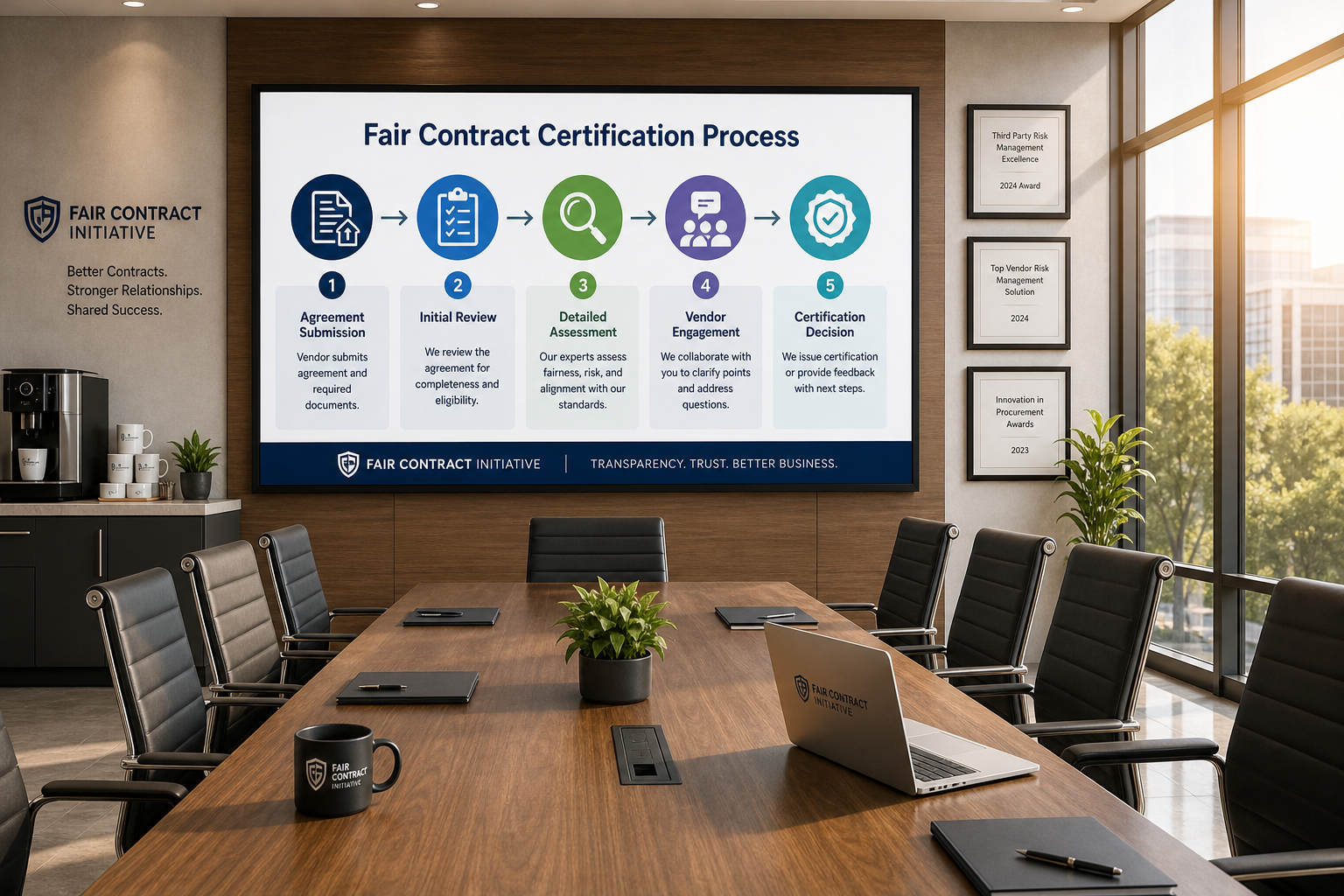
Contract certification services give procurement and legal teams an independent, data-backed method for verifying whether vendor agreements meet market standards before approvals move forward. Without that verification layer, organizations default to subjective assessments that slow deal cycles and leave risk gaps unaddressed.
This guide covers how contract certification services work, what they evaluate, and how procurement teams use certification data to strengthen due diligence, accelerate vendor onboarding, and reduce negotiation friction across contract portfolios.

Key Takeaways: Contract Certification Services
- Contract certification independently verifies vendor agreements against market benchmarks for fairness and balanced risk allocation.
- Procurement teams use certification data to prioritize contracts, reduce redlines, and accelerate approval cycles.
- Effective certification combines AI-powered contract analysis with human legal expert validation for accuracy.
- TermScout Certify™ provides objective scoring and TrustMark™ certification that signals market-aligned agreements.
- Integrating certification into due diligence workflows creates repeatable, auditable standards for vendor verification.
Download Your free Copy of the AI Vendor Contract Report
Click here
What Are Contract Certification Services?
Contract certification services evaluate vendor agreements against established benchmarks to determine whether terms are fair, balanced, and aligned with market norms. The process produces an objective assessment rather than a subjective opinion.
Certification typically examines specific contract provisions including liability caps, indemnification obligations, data handling terms, intellectual property clauses, and termination conditions. Each provision is scored against comparable agreements to identify deviations from accepted market standards.
The output is a structured certification result that procurement and legal teams can use as evidence during vendor onboarding, approval workflows, and audit responses. Contracts that meet defined thresholds receive a certification designation confirming market alignment.
Why Procurement Teams Need Contract Certification
Procurement organizations face increasing pressure to approve vendors faster while managing growing contract volumes. Manual approaches to evaluating agreement quality create inconsistencies that compound across portfolios.
A 2026 report from World Commerce and Contracting found that organizations lose an average of 11% of contract value post-signature. Much of that leakage stems from poorly evaluated terms, unclear obligations, and gaps in vendor due diligence processes.
Contract certification addresses these gaps by providing procurement teams with structured, comparable data about agreement quality before contracts reach the approval stage. Teams gain the ability to distinguish market-aligned agreements from those requiring deeper scrutiny or renegotiation.
The volume challenge is real. Fortune 1000 companies typically maintain 20,000 to 40,000 active contracts, many of which pass through procurement workflows. Without a scalable method for assessing agreement quality, individual reviewer bandwidth becomes the bottleneck for every vendor decision.
Certification creates a consistent baseline that procurement teams use to triage incoming agreements. Contracts that meet certification thresholds can proceed through approval workflows with reduced legal review, while agreements that fall below thresholds are flagged for negotiation or escalation.

See how your contract compares to the market
Upload a contract to get an analysis preview of how its terms stack up against the market.
How Contract Certification Services Work
Step 1: Contract Intake and Classification
The certification process begins with contract intake. Agreements are classified by type, including SaaS, IT, services, NDA, DPA, or vendor contracts. Classification determines which benchmarking dataset and scoring criteria apply to the evaluation.
Proper classification ensures that a SaaS agreement is compared against other SaaS agreements rather than against unrelated contract categories. This specificity produces more meaningful and actionable results.
Step 2: Clause-Level Analysis
Each agreement undergoes clause-level analysis where individual provisions are identified, extracted, and evaluated. Key contract positions examined include liability allocation, indemnification scope, intellectual property ownership, data privacy obligations, service level commitments, and termination rights.
The analysis answers a predetermined set of questions about how risk and responsibility are distributed between the parties. This structured approach produces findings that are comparable across agreements of the same type.
Step 3: Benchmarking Against Market Standards
Extracted contract positions are compared against real-world agreement data to determine whether each provision aligns with market norms. Market benchmarking reveals whether specific terms are standard, favorable, or unusually restrictive relative to comparable contracts.
Benchmarking transforms contract evaluation from an isolated exercise into a data-informed assessment. Procurement teams can see exactly where a vendor's terms stand relative to thousands of comparable agreements.
Step 4: Scoring and Certification
Based on the analysis and benchmarking results, the agreement receives a fairness score reflecting how contract positions compare to market standards. Agreements that meet defined thresholds and contain no deal-breaker clauses qualify for certification.
Certified contracts carry a verifiable designation that procurement, legal, and compliance teams can reference during approvals, audits, and governance processes.
What Contract Certification Evaluates
Certification services focus on the contract provisions that most frequently cause procurement friction, legal escalation, and negotiation delays. The following categories carry the most weight in the evaluation process.
Liability and Risk Allocation
Liability clauses define financial exposure when issues arise. Certification evaluates whether caps on damages, indemnification obligations, and limitations of liability distribute risk proportionally between the parties. Agreements where liability skews heavily toward one side create negotiation friction and approval delays.
Data Privacy and Security Obligations
Data handling terms govern how vendor agreements address privacy requirements, breach notification protocols, and security commitments. Certification assesses whether these provisions meet current regulatory expectations and market norms for the applicable contract risk categories.
Intellectual Property Rights
IP clauses determine who owns work product, who retains usage rights, and what happens to proprietary information after the relationship ends. Certification evaluates whether IP terms reflect accepted market practices for the specific contract type.
Termination and Renewal Conditions
Termination provisions define how and when either party can exit the agreement. Certification checks whether these conditions are balanced, including notice periods, termination-for-convenience rights, and data return obligations upon contract expiration.
Service Level Commitments
SLA provisions establish performance expectations and remedies when those expectations are not met. Certification evaluates whether service level terms include measurable performance standards, credit mechanisms, and escalation procedures that align with market practices.
Governing Law and Dispute Resolution
Governing law clauses determine which jurisdiction's laws apply to the agreement, and dispute resolution provisions define how conflicts are handled. Agreeing to resolve disputes in a foreign jurisdiction can significantly increase legal costs and complexity if problems arise. Certification flags provisions that deviate from market norms for the applicable contract geography.
The Role of Contract Certification in Procurement Due Diligence
Due diligence programs traditionally focus on financial stability, cybersecurity posture, and regulatory compliance. Contract certification adds a critical dimension that most vendor risk frameworks overlook: whether the agreement itself is fair and market-aligned.
Without contract-level evaluation, procurement teams approve agreements based on incomplete risk signals. A vendor may pass every security questionnaire and financial assessment while presenting contract terms that contain disproportionate risk allocation or non-standard obligations.
Contract certification closes this gap by producing structured evidence that complements existing due diligence data. The result is a more complete picture of vendor risk that accounts for both organizational readiness and contractual fairness.
Where Certification Fits in the Due Diligence Framework
Think of due diligence as a multi-layer assessment. Financial audits verify solvency. Security assessments verify data protection capabilities. Compliance checks verify regulatory alignment. Contract certification verifies that the agreement governing the relationship reflects market norms for fairness, obligations, and risk distribution.
Each layer addresses a different risk vector. Removing any single layer leaves a gap that the others cannot fill. Procurement teams that incorporate certification into their due diligence framework evaluate vendors more consistently and produce stronger documentation for audit and regulatory responses.
How Contract Certification Supports Vendor Verification
Vendor verification confirms that a supplier can deliver on its commitments. Contract certification strengthens verification by providing objective evidence about the terms governing that relationship.
Pre-Contract Vendor Assessment
Certification data gives procurement teams a structured evaluation of agreement quality before contract execution. Teams can identify which vendor agreements require negotiation, which can move forward with minimal changes, and which present unacceptable risk.
Ongoing Governance and Monitoring
Contract certification establishes a documented baseline for each vendor relationship. When agreement terms change through amendments, renewals, or renegotiations, teams can compare updated terms against the original certification to identify meaningful shifts in contract posture.
Audit and Regulatory Response
Certification produces auditable records of contract evaluation that support regulatory inquiries and internal governance reviews. Procurement teams can demonstrate that vendor agreements were assessed against objective standards rather than subjective judgment alone.
Key Benefits of Contract Certification for Procurement
Faster Approval Cycles
Certified contracts move through approval workflows faster because procurement and legal teams receive structured evidence of market alignment upfront. Teams spend less time debating whether terms are acceptable and more time executing on sourcing strategy.
Reduced Negotiation Friction
When both parties can reference objective certification data, negotiations focus on genuine business requirements rather than positional disagreements about what constitutes "standard" terms. TermScout's TrustMark™ certification provides vendors with independent verification that their agreements meet market norms, reducing the volume of redlines procurement teams need to process.
Consistent Risk Evaluation
Manual contract evaluations produce inconsistent results because they depend on individual reviewer expertise and bandwidth. Certification provides a standardized methodology that delivers comparable assessments across contracts, vendors, and business units.
Improved Vendor Relationships
Transparent evaluation criteria build trust between buyers and suppliers. Vendors who invest in contract certification signal that they value fairness and are willing to have their terms independently verified.
Stronger Compliance Documentation
Certification records provide defensible documentation for audits, regulatory inquiries, and internal compliance reviews. Teams can demonstrate that vendor agreements were evaluated using objective, repeatable criteria.
How to Integrate Contract Certification Into Your Procurement Workflow
Map Your Current Contract Evaluation Process
Start by documenting how your team currently evaluates vendor agreements. Identify where subjective assessments create bottlenecks, inconsistencies, or risk gaps. These friction points reveal where certification data adds the most immediate value.
Define Certification Criteria and Thresholds
Establish which contract types require certification and what thresholds trigger escalation. High-value, high-risk, or strategically important vendor agreements typically benefit most from independent certification.
Build Certification Into Vendor Onboarding
Integrate certification as a standard step in your vendor onboarding process. Require certification evidence alongside financial, security, and compliance documentation to create a complete vendor risk profile.
Establish a Certification Baseline for Ongoing Monitoring
Use initial certification results as the baseline for each vendor relationship. Track how contract positions change over time and flag significant deviations from the certified terms for legal or procurement attention.
Train Procurement and Legal Teams on Certification Data
Ensure that team members understand how to interpret certification results, use scoring data in negotiations, and reference certification records during audits. Adoption depends on the team's ability to translate certification insights into procurement decisions.
What to Look for in a Contract Certification Provider
Not all certification approaches deliver equal value. When evaluating providers, prioritize these capabilities.
Independent, Objective Methodology
Certification must be based on a transparent, consistent methodology rather than proprietary black-box scoring. The evaluation criteria, benchmarking data sources, and scoring treatments should be documented and repeatable.
Real-World Benchmarking Data
Effective certification requires comparison against actual market agreements, not theoretical best practices. The benchmarking dataset should include thousands of real-world contracts across multiple contract types and industries.
AI-Powered Analysis Combined With Human Validation
AI accelerates clause extraction and pattern recognition, but human legal expertise is essential for interpreting nuanced provisions and validating certification outcomes. TermScout combines AI-powered contract analysis with human legal expert validation to deliver 99% accuracy in contract signal identification.
Structured, Auditable Output
Certification results should produce structured data that integrates with your existing procurement systems, risk management platforms, and governance workflows. Look for providers that deliver machine-readable output alongside human-readable reports.
Contract Certification by Industry
Certification requirements and priorities vary by industry because different sectors carry different regulatory pressures, contract structures, and risk profiles. The following examples illustrate how contract certification adapts to specific industry contexts.
Technology and SaaS
Technology procurement involves contracts with complex data handling provisions, IP ownership terms, and SLA structures. Certification helps procurement teams evaluate whether vendor agreements align with market standards for data processing obligations, uptime commitments, and liability frameworks specific to software and cloud services.
Financial Services
Financial institutions face stringent regulatory oversight that extends to third-party vendor relationships. Certification provides auditable evidence that vendor contract terms meet expectations for data security, business continuity, and risk allocation that regulators expect to see during examination.
Healthcare
Healthcare organizations manage vendor agreements with specific requirements around protected health information, breach notification, and regulatory compliance. Certification evaluates whether these provisions reflect current market standards and regulatory expectations for healthcare vendor contracts.
Manufacturing and Supply Chain
Manufacturing contracts often involve complex performance obligations, quality standards, and multi-tier supplier relationships. Certification helps procurement teams assess whether vendor terms for warranties, liability allocation, and force majeure provisions align with market practices in industrial procurement.
Common Misconceptions About Contract Certification
Certification Is Not Legal Advice
Contract certification evaluates agreement terms against market benchmarks and established scoring criteria. It does not replace legal counsel or provide guidance on how to structure specific contractual arrangements. Certification data informs decisions; legal teams make them.
Certification Does Not Guarantee Contract Performance
A certified contract confirms that terms are fair and market-aligned at the time of evaluation. It does not guarantee that either party will fulfill its obligations. Performance monitoring and contract governance processes remain essential after certification.
Certification Is Not One-Time
Vendor agreements change through amendments, renewals, and renegotiations. Certification should be an ongoing process that tracks how contract positions evolve relative to market standards over time.
How TermScout Certify™ Delivers Contract Certification
TermScout built Certify™ to address the specific challenges procurement and legal teams face when evaluating vendor agreements at scale. The platform combines AI-powered contract analysis with market benchmarking and independent legal validation.
Certify™ analyzes contracts clause by clause, generates Contract Signals that highlight risk, non-standard language, and key terms, and benchmarks each provision against thousands of real-world agreements. Agreements that meet certification criteria receive TrustMark™ certification, confirming balanced terms and the absence of deal-breaker clauses.
For procurement teams, this means faster triage, consistent risk evaluation, and structured evidence that supports vendor onboarding, governance, and audit responses. Legal teams gain clause-level visibility into where agreements deviate from market standards, enabling more focused and efficient negotiations.
Role-Specific Value From Certification
Procurement Teams: Identify which vendor agreements can move forward quickly and which require escalation based on objective scoring rather than individual reviewer assessment.
Legal Teams: Focus negotiation effort on the specific clauses where vendor terms deviate from market standards rather than reviewing every provision from scratch.
Compliance Teams: Access structured certification records that support audit preparation, regulatory responses, and internal governance documentation.
RevOps Teams: Improve deal forecasting by understanding how contract quality affects approval timelines and deal velocity across the vendor portfolio.
FAQs About Contract Certification Services
What is a contract certification service?
A contract certification service independently evaluates vendor agreements against market benchmarks to verify that terms are fair, balanced, and aligned with accepted standards. Certification produces structured, auditable evidence procurement teams use during approvals and vendor onboarding.
Which contract types can be certified?
Common certifiable contract types include SaaS agreements, IT contracts, NDAs, DPAs, services agreements, vendor and supplier contracts, and AI-related agreements. TermScout Certify™ benchmarks these agreement types against real-world market data to determine certification eligibility.
How does contract certification reduce procurement risk?
Certification identifies non-standard provisions, disproportionate risk allocation, and potential deal-breaker clauses before contract execution. This earlier visibility enables procurement teams to address issues proactively rather than discovering them during or after the approval process.
Does contract certification replace legal counsel?
Contract certification does not constitute legal advice. It provides data-driven benchmarking and objective scoring that inform legal and procurement decisions. Organizations should use certification data alongside professional legal oversight for complete risk management.
How does TermScout's TrustMark™ certification work?
TermScout's TrustMark™ certification evaluates contracts using AI-powered analysis validated by legal experts. Agreements that demonstrate balanced terms, proportional risk allocation, and the absence of deal-breaker clauses qualify for certification, providing buyers and vendors with an independent trust signal.
How often should vendor contracts be recertified?
Recertification is recommended whenever agreements are amended, renewed, or renegotiated. Market standards evolve, and provisions that were aligned at initial signing may drift from current norms over time. Ongoing certification tracking ensures your vendor relationships remain market-aligned.
Building Stronger Due Diligence With Contract Certification
Contract certification services transform how procurement and legal teams evaluate vendor agreements. By replacing subjective assessments with structured, benchmarked analysis, certification gives your team the evidence needed to approve vendors faster, reduce negotiation friction, and build stronger compliance documentation.
Organizations that embed certification into their procurement workflows gain a repeatable, auditable methodology for contract evaluation that scales with growing vendor portfolios and increasing regulatory expectations.
TermScout Certify™ delivers the contract intelligence, market benchmarking, and independent certification that procurement teams need to make faster, more confident vendor decisions. Explore how Certify™ works and see what your contracts reveal.

Gautam Joshi
Founding Growth Manager
Gautam Joshi Founding Growth Manager at TermScout leverages marketing expertise by combining data-driven brand strategy, messaging, demand generation, and sales enablement to boost revenue and streamline deals.
Share this

What Is Contract Certification for Vendor Risk Teams

Fair Contract Certification in Vendor Risk Management