.png?width=130&height=53&name=Vector%20(21).png "TermScout Logo")

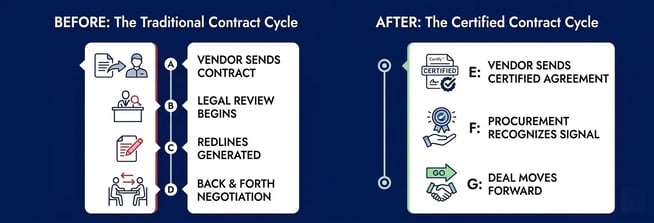
There's a quiet ritual happening in procurement departments everywhere. A vendor sends over their standard agreement. Legal opens the PDF, sighs, and begins marking it up. Weeks pass. The deal technically exists — everyone wants it to close — but the contract sits in a queue, waiting for someone with enough context to decide whether it's actually reasonable.
This is not a rare situation. It's practically the default. And the core problem isn't the contract itself — it's the absence of any independent reference point for what "fair" actually looks like.
That's exactly what contract certification is designed to solve.
Why Vendors Can't Define Their Own Fairness
Vendors have long tried to pre-empt legal scrutiny by labeling their terms "standard" or "market-aligned." Sometimes they invest in plain-language rewrites. Sometimes they add an FAQ alongside the agreement. These are reasonable gestures — but they share the same flaw: the vendor is grading their own work.
A procurement professional evaluating a new vendor has no reason to take that framing at face value. They know the vendor wrote the contract to protect the vendor. So they review from scratch, bring in legal counsel, and the clock starts ticking.
Contract certification flips this dynamic. Rather than asking the buyer to assess fairness alone, it provides an independent standard that both parties can reference. The terms have been evaluated not by the vendor's legal team, but by an outside authority using defined criteria and real-world comparative data. That shifts the conversation from "we think our terms are reasonable" to "an independent analysis confirms these terms meet defined fairness standards."
The difference sounds subtle. The practical impact on deal velocity is anything but.
How TermScout Actually Measures Contract Fairness
TermScout's approach to contracts certification isn't based on impressions or general legal opinion. It's built on a repeatable, consistent methodology applied the same way across every agreement reviewed.
For every contract that goes through the process, the same pre-determined questions are asked. The same rating algorithm runs. The same variables are evaluated — regardless of the vendor category, deal size, or industry. That consistency is what makes the data meaningful. Without it, you can't benchmark one agreement against thousands of others, because every review would reflect the individual judgment of whoever happened to be looking at it that day.
The Scoring Breakdown: What the Ratings Mean
The rating system is built around a simple favorability scale:
|
Rating |
What It Means |
|
Customer Favorable |
More than 60% of terms benefit the customer |
|
Balanced |
Neither party holds less than 40% of the advantage |
|
Vendor Favorable |
More than 60% of terms benefit the vendor |
Only agreements rated Balanced or Customer Favorable — with zero deal breaker clauses — can earn TrustMark™ certification. Vendor-favorable contracts don't qualify, full stop. The threshold isn't flexible, and that's intentional.
The scoring aligns with the WorldCC Contracting Principles, an independent framework for balanced commercial agreements. This gives the methodology an external anchor — one that exists entirely outside of TermScout.
AI Analysis + Human Review: Why Both Matter
The process combines two layers that each do something the other can't:
- AI-backed analysis processes contracts clause by clause, extracts favorability data, and applies the rating algorithm consistently at scale
- Human legal reviewers then validate the output — checking for ambiguous language, contextual nuance, and completeness before any contract certification is issued
The human layer isn't redundant. It's the quality check that makes the output trustworthy to experienced procurement and legal professionals who know exactly what to probe.
What "Answer Varies" Actually Tells You
One of the more useful — and often misunderstood — aspects of TermScout's contract certification methodology is how it handles ambiguity. When a clause is genuinely vague or incomplete, the system doesn't force a clean favorable/unfavorable rating. Instead, it assigns a clarity level to the finding.
This is more valuable than it sounds.
A result of "Answer Varies" on a specific clause isn't a failure of the review. It's an honest signal that the contract language is unclear — and that is itself a finding worth knowing. Ambiguity in a contract isn't neutral. It creates risk for both parties. Naming it explicitly is more useful than papering over it with a confident-sounding rating that isn't actually warranted.
Three Clarity Levels, Three Kinds of Information
|
Clarity Level |
What It Signals |
|
High Certainty |
The clause is clear; the rating reflects what the contract actually says |
|
Moderate Certainty |
Some interpretation was required; the rating is reasonable but not definitive |
|
Answer Varies |
The language is ambiguous; risk exists regardless of which party it favors |
A procurement team reviewing a certified agreement can see exactly where confidence is high, where it's moderate, and where the contract leaves room for interpretation. That's a level of transparency that traditional legal review rarely delivers.
TrustMark™: What the Badge Actually Represents
The Qualification Bar Is Deliberately High
Earning the TrustMark™ is not automatic. Contracts go through the full analysis process — and most don't qualify on the first pass. To receive certification, an agreement must meet all of the following:
- Rated Balanced or Customer Favorable by the scoring algorithm
- Validated by human legal reviewers for accuracy and completeness
- Contains zero deal breaker clauses — no exceptions
If a contract is vendor-favorable, or if even one clause triggers a deal breaker flag, it doesn't receive certification. The selectivity is the point. If every contract that went through the process came out certified, the badge would communicate nothing.
What Comes With the Contract Certification
Once certified, the vendor receives more than a badge. Each TrustMark™ includes a Contract Certification Report that documents:
- How the agreement rates against real-world contracts in the same category
- Which clauses scored favorably, which scored neutrally, and where ambiguity exists
- The overall fairness rating and the data behind it
This report is designed to function as proof — not just an assertion. Vendors share it with buyers. Procurement teams use it during intake. Legal teams reference it to reduce the depth of their own review.
-Mar-26-2026-10-22-14-5016-AM.webp?width=654&height=230&name=image3%20(1)-Mar-26-2026-10-22-14-5016-AM.webp)
Why Different Teams Care About This Differently
Contract certification doesn't mean the same thing depending on who's looking at it. The same badge carries a different value depending on where someone sits in the deal cycle.
Here's how each team actually benefits:
For Legal
- Reduces the volume of agreements requiring intensive manual review
- Focuses attention on high-risk escalations rather than routine assessments
- Provides an independent starting point rather than a blank page
For Procurement
- Speeds up contract triage at intake
- Removes the need to build or maintain an internal benchmark database
- Creates a consistent, defensible standard for evaluating vendor terms
For Sales and Revenue Operations
- Shortens the time between proposal and signature
- Removes the "contract conversation" as a recurring stall point
- Turns the agreement itself into a trust signal rather than a friction source
The companies that have gone through TrustMark™ certification — including names like Freshworks, Atlassian, Lenovo, and Siemens — have done so largely because of this last point. Deals that stall at contract review are expensive. A contract certification that eliminates even a portion of that friction has a measurable commercial impact.
The Problem With Self-Attestation
There's a broader principle at work here. When a company evaluates its own terms and then communicates that evaluation to the market, the inherent conflict of interest limits how much weight buyers can place on it. Not because vendors are dishonest — but because the incentive structure creates an unavoidable credibility gap.
Third-party contracts certification addresses that gap directly:
- The evaluation is conducted by an independent authority
- The scoring criteria are defined in advance and applied consistently
- The methodology aligns with recognized external principles
- The certification only applies when the terms actually meet the standard
A self-described "fair" contract and a certified contract both claim the same thing. Only one of them can prove it.
Conclusion
Contract certification is not a paperwork exercise. It's a structural change in how trust gets established between vendors and buyers. The traditional model — vendor writes contract, buyer scrutinizes it, both sides negotiate toward something acceptable — is slow, expensive, and relies heavily on who's in the room.
TrustMark™ certification replaces a process built on suspicion with one built on verified data. Legal teams spend less time on routine review. Procurement moves faster through intake. Sales cycles shorten. And the contract — usually the last bottleneck before signature — becomes the thing that builds confidence instead of eroding it.
For vendors willing to hold their agreements to an independent standard, the upside is clear. The market is starting to notice who's willing to show their work.
Share this
-Mar-26-2026-10-30-55-2165-AM.webp)
The Anatomy of a Certified Contract: What the TrustMark Actually Validates
-Mar-26-2026-10-40-28-6193-AM.webp)
The Fast Track: How Contract and Procurement Certification Shortens the Sales Cycle
-Mar-02-2026-02-02-28-2638-PM.webp)