.png?width=130&height=53&name=Vector%20(21).png "TermScout Logo")

Every procurement team knows the painful truth: most of their time gets consumed reviewing contracts that shouldn't have made it to their desk in the first place. Vendors submit agreements with egregious liability disclaimers, problematic data usage terms, or one-sided termination clauses. Procurement dutifully reviews each one, documents the issues, explains why the terms are unacceptable, and sends rejection notices—weeks after receiving the contract.
This review-then-reject pattern wastes enormous capacity. The time spent analyzing contracts that will ultimately be declined could have been invested in evaluating viable vendors, negotiating with legitimate contenders, or providing strategic guidance on complex agreements.
The assumption that drives this inefficiency is simple: procurement must read contracts thoroughly before deciding whether they're acceptable. This seems reasonable until you recognize that many contracts fail basic acceptability standards that could be verified instantly. Smart procurement recognizes that saying no faster to contracts that fail basic standards frees capacity for the deals that actually deserve attention.
The Real Cost of Reviewing Everything That Arrives
The principle sounds responsible: every contract deserves careful evaluation before procurement makes decisions. In practice, this principle creates the contract delay that frustrates everyone. Procurement queues stretch for weeks. Vendors complain about slow responses. Internal stakeholders pressure procurement to move faster.
-Mar-02-2026-10-43-40-5581-AM.webp?width=654&height=439&name=image2%20(1)-Mar-02-2026-10-43-40-5581-AM.webp)
Why Comprehensive Review Doesn't Scale
The root problem is that a comprehensive review doesn't scale. When procurement receives five vendor contracts, reviewing all five is manageable. When they receive fifty, a comprehensive review becomes impossible within reasonable timeframes.
Consider what happens without effective triage:
The inefficient cycle:
- Procurement receives a vendor contract with an unlimited liability disclaimer
- An analyst spends three hours reviewing the entire document
- They extract key provisions and compare terms to standards
- They document findings in a detailed rejection notice
- Those three hours produced zero value because the contract was never viable
The False Economy of Detailed Rejections
Procurement teams often feel obligated to explain precisely why they're rejecting contracts. This seems courteous and professional. The vendor submitted a proposal; they deserve detailed feedback about what made their terms unacceptable.
This thoroughness is expensive. Creating detailed rejection documentation takes almost as long as conducting the review itself. For contracts that fail basic acceptability standards, this investment makes no sense.
Smart procurement distinguishes between contracts worth negotiating and contracts that should be rejected immediately. Viable contracts with a few problematic provisions deserve detailed feedback. Contracts with fundamental structural problems deserve quick rejection with minimal documentation.
How Contract Triage™ Creates Instant Clarity
Contract intelligence tools for procurement enable a fundamentally different approach. Instead of treating every contract as requiring comprehensive analysis, AI contract solutions for procurement act as a decision gate that quickly categorizes agreements.
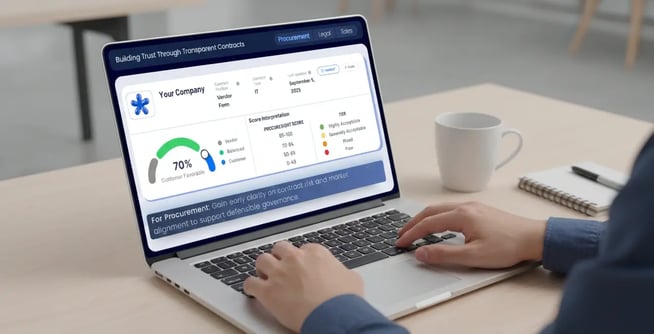
The Three Signals That Change Everything
Effective triage requires clear categories with unambiguous decision rules. Contract Triage™ provides exactly this structure through three signal types that tell procurement exactly what each contract requires.
Green signal contracts:
- Meet or exceed market standards across key provisions
- Contain zero deal-breaker clauses
- Can move through procurement quickly with streamlined review
- Verification that standards are met has already occurred through automated analysis
Yellow signal contracts:
- Contain some provisions that warrant attention but aren't automatically disqualifying
- Deserve a traditional procurement review where analysts evaluate specific terms
- Triage analysis points procurement toward which provisions require focus
- Make the review more efficient, even when human judgment is needed
Red signal contracts:
- Contain deal-breaker provisions or severe overall imbalance
- Appropriate for rejection without extensive review
- Automated analysis provides documentation for why rejection occurred
- Eliminate the need for procurement to create detailed explanations
The Upload-Score-Focus Workflow
Implementing smart procurement through Contract Triage™ follows a straightforward three-step workflow:
- Upload: When procurement receives a vendor contract, it gets uploaded for automated contract analysis.
- Score: The system analyzes the contract against market standards. Within minutes, procurement receives objective signals about contract scoring.
- Focus: Green signal contracts move forward quickly. Yellow signal contracts get assigned to analysts for focused review. Red signal contracts get rejected.
Making Rejection Decisions Defensible
Procurement teams that reject contracts quickly sometimes face pushback. Vendors complain that their terms weren't given fair consideration. Internal stakeholders question whether procurement is being too rigid. Finance wants to know if potentially good vendors are being excluded arbitrarily.
-Mar-02-2026-10-46-50-6475-AM.webp?width=654&height=504&name=image3%20(1)-Mar-02-2026-10-46-50-6475-AM.webp)
From Subjective Judgment to Objective Assessment
Contract intelligence tools for procurement solve this defensibility problem by providing objective criteria for quick rejections. When procurement says, "Your contract contains deal-breaker provisions that violate our standards," the vendor might argue that's unfair.
When procurement says, "your contract was automatically flagged for disclaiming all vendor liability, a provision that appears in less than 2% of market-standard agreements and creates unacceptable risk," the rejection becomes defensible.
The difference is specificity backed by market data. Smart procurement uses automated analysis to identify exactly which provisions triggered rejection and how those provisions compare to market norms. This transforms subjective judgment into objective assessment.
How Certified Contracts Skip the Line
The Contract Triage™ system builds on the same contract intelligence that powers TermScout's TrustMark certification. This creates powerful synergies when vendors pursue certification proactively.
A vendor with certified contracts submits agreements that have already been verified against market standards and confirmed free of deal-breakers. When certified contracts enter the triage workflow, they automatically receive green signals because the certification process already confirmed they meet quality thresholds.
This creates incentive for vendors to pursue certification—it enables their contracts to move through procurement with minimal friction. Buyers gain efficiency through pre-verified contracts that bypass extensive review. Sellers gain faster procurement cycles by demonstrating upfront that their terms meet standards.

The Numbers That Matter: Time Reclaimed
The efficiency gains from smart procurement compound quickly across contract volume. Consider a procurement team that reviews 200 vendor contracts annually. Under traditional comprehensive review, each contract requires an average of 4 hours from intake to decision. That's 800 hours annually—half of a full-time employee's capacity.
With Contract Triage™ providing instant assessment:
- Roughly 30% of contracts (60 total) get rejected within minutes based on deal-breaker identification
- Previously consumed 240 hours, now handled in perhaps 10 hours total
- Another 40% (80 contracts) receive green signals and move through streamlined review
- Require 1 hour instead of 4, saving 240 additional hours
- The remaining 30% still require full review, but with focused attention on specific provisions
The cumulative impact: 800 hours of traditional review becomes roughly 350 hours with automated triage. That's 450 hours annually—more than 10 weeks—of procurement capacity reclaimed through saying no faster to unacceptable contracts and yes faster to routine ones.
Quality Improvements Beyond Speed
Smart procurement delivers benefits beyond time savings. When procurement can focus analytical capacity on contracts that genuinely require expert judgment, the quality of that analysis improves. Analysts aren't rushing through reviews to clear backlogs—they're investing appropriate time in agreements where thorough evaluation matters.
The confidence to reject contracts quickly also improves procurement's strategic positioning. Vendors learn that submitting substandard contracts wastes everyone's time. Over time, vendors either improve their standard terms to meet market norms or self-select out of procurement processes where their terms won't be acceptable.
Building Procurement That Scales
Smart procurement recognizes that a comprehensive review of every contract isn't thorough—it's wasteful. When contracts fail basic acceptability standards, discovering that failure after five hours provides no more value than discovering it after five minutes.
Contract intelligence tools for procurement transform this dynamic by positioning automated analysis as a decision gate rather than a review burden. The triage process identifies which contracts deserve human attention and which should be rejected immediately.
This isn't about cutting corners or making careless decisions—it's about allocating scarce analytical capacity to where it creates value. The vendors who succeed in this environment are those who recognize that meeting basic contract standards is table stakes for efficient procurement.
For procurement teams stretched thin by increasing contract volumes, saying no faster to unacceptable agreements is the key to saying yes faster to viable ones. The capacity reclaimed through automated rejection of deal-breaker contracts can be redirected toward the strategic work that actually requires procurement expertise.
Explore how Contract Triage™ can help your procurement team say no faster to problematic contracts and yes faster to viable ones.
Improving procurement decisions without overburdening teams requires acknowledging that manual analysis doesn't scale. Contract intelligence provides a path to systematize repetitive work while preserving human judgment for strategic tasks.
The result is a procurement function that provides better recommendations, makes faster decisions, and operates sustainably. Teams can focus on the work that actually requires their expertise—rather than drowning in repetitive baseline verification.
Ready to see how procurement contract AI can transform your procurement process? Explore TermScout's TrustMark demo to experience certified contract analysis firsthand.
Share this
-Mar-26-2026-11-12-38-5404-AM.webp)
The SaaS Trap: Why IT Contract Benchmarking is No Longer Optional
How to Improve Procurement Decisions Without Overburdening Your Team
-Mar-26-2026-10-58-08-9262-AM.webp)