.png?width=130&height=53&name=Vector%20(21).png "TermScout Logo")

The deal is essentially done. Pricing has been negotiated. The customer loves the product. Sales leadership is forecasting the revenue. Then the contract arrives in legal review, and everything grinds to a halt. What should take days stretches into weeks. What seemed like a sure thing becomes uncertain as procurement raises questions, legal counsel requests changes, and approvals stall at various levels.
This final stage—between agreement in principle and actual signature—represents the most frustrating phase of modern B2B sales. It's where deals that should close don't, where forecasts miss, and where both buyers and sellers waste enormous amounts of time on preventable friction.
Contract execution suffers from a peculiar challenge. Earlier sales stages have clear metrics and established processes. But the final contract review phase remains a black box for many organizations. Deals disappear into legal departments and emerge weeks later—or don't emerge at all.
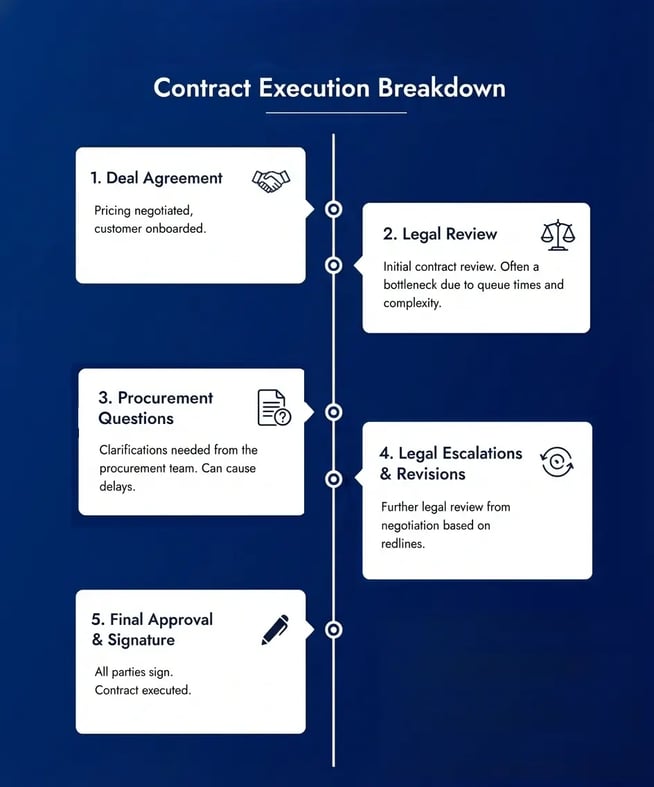
Where Your Deals Actually Disappear
Contract execution breaks down in predictable places, yet most companies struggle to identify exactly where the bottlenecks form. Understanding the specific failure points reveals why traditional solutions often miss the mark.
The Legal Review Queue That Never Ends
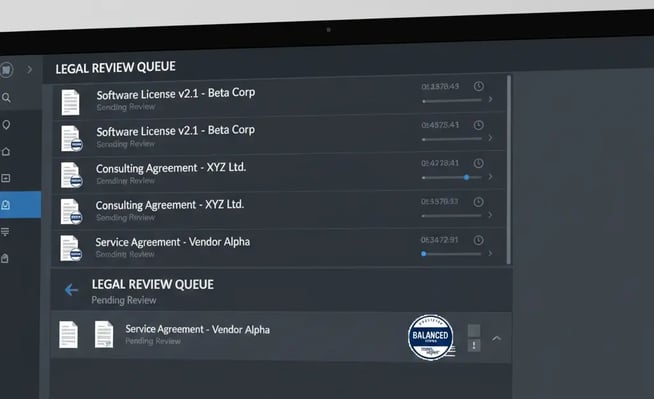
Every co triggers a review process on the buyer side. For small and mid-market companies, that might mean the contract lands with an overworked general counsel who's also handling employment issues, regulatory compliance, and a dozen other priorities. For enterprises, it means entering a formal queue where contracts wait their turn behind dozens of others.
The math works against fast contract execution. A typical legal department at a mid-market company might handle 50-100 vendor contracts per quarter. Each contract requires reading, analysis, comparison to company standards, identification of risky provisions, and documentation of concerns.
This backlog creates perverse incentives. Sales teams push contracts into the queue as early as possible, which increases queue length for everyone. Buyers learn that threatening to walk away sometimes bumps their contract up in priority.
TermScout's certification helps vendors skip the longest queues by providing buyers with pre-verified contract analysis.
-Feb-03-2026-06-53-03-3092-AM.webp?width=654&height=357&name=image2%20(1)-Feb-03-2026-06-53-03-3092-AM.webp)
The Information Black Hole
When legal counsel finally reviews the contract, they face an information deficit. They don't know whether the liability cap is standard for this vendor category. They can't tell if the termination rights are more or less favorable than alternatives.
This deficit forces legal teams into conservative default positions:
- Unable to distinguish standard terms from outliers, they redline anything that looks unusual
- Unable to assess risk severity, they escalate minor deviations to leadership unnecessarily
- Unable to benchmark against comparable agreements, they spend hours researching what "market standard" means
- Unable to verify vendor claims of fairness, they must conduct an independent analysis from scratch
All of this takes time. More problematically, it creates friction that slows contract execution even when the underlying terms are perfectly reasonable. A contract that's actually quite favorable to the buyer might generate extensive redlines simply because the buyer's legal counsel can't verify that claim.
Why Nobody Trusts What Vendors Say
Behind the information deficit sits a deeper trust problem. Buyers assume vendor contracts favor the vendor. This assumption isn't unreasonable—vendors do generally write contracts that protect their interests. But it means every contract starts with a credibility deficit that must be overcome.
Vendors who claim "our terms are standard" or "this contract is fair" face immediate skepticism. Without independent validation, these assurances carry little weight. Procurement teams have heard these claims from vendors whose contracts turned out to be egregiously one-sided.
This trust gap extends contract execution timelines because it forces buyers to conduct their own verification. Rather than accepting vendor claims, they must analyze provisions themselves, benchmark against other contracts, and validate fairness independently.
TermScout's independent certification solves the trust problem by providing third-party validation that neither buyer nor seller can manipulate.
Why Your Current Solutions Aren't Working
Most companies try to solve slow contract execution with approaches that sound logical but fail to address root causes. These half-measures provide marginal improvements while leaving the fundamental problems intact.
-4.webp?width=654&height=357&name=image3%20(1)-4.webp)
Hiring More Lawyers Just Speeds Up the Wrong Process
The obvious solution to legal review bottlenecks seems straightforward: hire more lawyers. If the queue is too long, add capacity.
But capacity alone doesn't solve the information deficit or trust gap. More lawyers reviewing contracts faster still need to research market standards, assess risk, and validate fairness. They still face skepticism about vendor claims.
Moreover, hiring more lawyers is expensive. For many mid-market companies, the math doesn't work. They'd need significant revenue growth to justify expanding legal teams proportionally to contract volume.
Template Wars Create New Bottlenecks
Another common approach: develop standard contract templates that legal has pre-approved, then insist that vendors use these templates instead of their own.
In practice, this works for small purchases but breaks down for larger deals. Enterprise vendors with established contract terms resist using customer templates. They've invested in developing contracts that work for their business model and have been negotiated successfully with hundreds of other customers.
|
Approach |
Theory |
Reality |
Why It Fails |
|
Hire More Lawyers |
More capacity = faster reviews |
Reviews still take same time per contract |
Doesn't address information deficit or trust gap |
|
Impose Templates |
Pre-approved terms = no review needed |
Vendors refuse; negotiation starts from scratch |
Creates template warfare instead of eliminating friction |
|
Negotiation Training |
Better skills = smoother process |
Sales reps negotiate better but can't verify fairness |
Doesn't provide the information buyers actually need |
|
Process Automation |
Technology speeds workflow |
Faster routing of contracts that still need full review |
Speeds symptoms, not root causes |
The result is template warfare: buyers insist on their paper, vendors insist on theirs, and contract execution stalls. Neither side trusts the other's starting point, so they end up negotiating heavily regardless of which template serves as the base.
Certified contracts eliminate template warfare by providing independent proof that vendor terms are fair and market-aligned. Learn how TermScout certification can accelerate your deals.
What Actually Breaks the Bottleneck
The solution to slow contract execution isn't working harder or faster—it's changing what information is available when the review begins. Independent validation fundamentally alters the dynamics that create procurement bottlenecks.
How Independent Certification Changes Everything
Contract execution accelerates dramatically when buyers can verify fairness at the outset rather than discovering it through a lengthy review. Independent certification provides this verification, fundamentally changing the information available when legal review begins.
When a contract displays a TermScout certification badge, buyer legal counsel immediately knows several things:
- The contract has been analyzed against hundreds of data points
- It's been compared to thousands of real-world agreements
- It's been rated as balanced or customer-favorable by an independent third party
- It contains zero deal-breaker clauses that would automatically disqualify it
This information eliminates days or weeks of research that would otherwise be necessary. The certification doesn't eliminate legal review entirely—buyers have company-specific concerns that generic certification can't address. But it eliminates the baseline verification work that consumes so much time.
Legal counsel can skip straight to "does this contract meet our specific needs?" rather than starting with "is this contract reasonable at all?" This shift dramatically compresses timelines. What might have taken two weeks can happen in a single review cycle.

Why Simplified Reports Work Better Than Raw Data
Certification badges signal overall contract quality, but buyers often need more detail during review. Which specific provisions are customer-favorable versus balanced? How does this contract compare to alternatives?
Simplified certification reports answer these questions without requiring buyers to conduct independent research. The reports break down contract terms by category, show how each provision compares to market standards, and highlight areas where the contract deviates from typical terms.
For SMB and mid-market buyers with limited legal resources, these reports are particularly valuable. A general counsel can read a certification report in 15 minutes and understand what they need to know about the contract's fairness.
Enterprise buyers benefit differently. Their legal teams have more capacity, but they review more contracts. Certification reports help them triage effectively—identifying which contracts need deep review and which can move through quickly.
The Competitive Edge Nobody Talks About
For vendors, certification does more than accelerate individual deals—it creates systematic competitive advantage. When buyers compare multiple vendors with similar products and pricing, the certified vendor has a clear edge in executing the contract phase.
Buyers facing deadlines to complete procurement don't just care about which product is best. They care about which deal they can actually close before the deadline. A slightly inferior product with a certified contract that will close in two weeks beats a slightly better product with an uncertain contract that might take two months.
This advantage compounds over time. As more buyers experience faster contract execution with certified vendors, reputation spreads. Procurement professionals share information about which vendors are easy to work with and which create friction.
How Different Companies Should Use This
The path to eliminating bottlenecks in contract reviews looks different depending on company size and resources. Each segment benefits from certification but in distinct ways.
For Small and Mid-Market Buyers: Instant Expertise
Small and mid-market buyers experience the most dramatic improvement. These organizations typically lack specialized contract expertise. Their general counsel handles contracts alongside many other responsibilities.
For these buyers, certification essentially provides instant contract expertise. Instead of learning enough about SaaS contracts to evaluate vendor terms independently, they can rely on independent validation.
Key benefits for SMB/mid-market:
- Eliminates the need for expensive external counsel on standard reviews
- Reduces general counsel workload so they can focus on strategic matters
- Enables faster procurement decisions without sacrificing due diligence
- Provides defensible documentation for internal stakeholders questioning vendor selection
For Enterprise Buyers: Scalable Throughput
Enterprise buyers with substantial legal teams gain different benefits. They have legal resources but face high contract volumes. Certification helps them manage queue length by reducing per-contract review time.
It also helps standardize evaluation—rather than each lawyer applying slightly different standards, certification provides a consistent baseline assessment across all certified contracts.
For Vendors: Turning Friction Into Advantage
Vendors looking to improve their contract execution rates should start by understanding whether their contracts qualify for certification. The standards are clear: balanced or customer-favorable overall terms, zero deal-breaker clauses, and alignment with market standards.
Many vendors discover their contracts are closer to qualifying than expected. They might have one or two problematic provisions that prevent certification, but could be modified without fundamentally changing their risk profile.

Making It Work In Practice
Understanding why certification helps is different from actually implementing it. Both vendors and buyers need concrete steps to translate the concept into faster contract execution.
Vendor Implementation Path
Vendors should begin by submitting their standard contracts for analysis. TermScout's process evaluates the contract against market benchmarks, identifies any provisions that would prevent certification, and provides detailed feedback on how terms compare to standards.
For vendors whose contracts already meet certification standards, the process is straightforward. For those needing modifications, the analysis identifies exactly which changes would make the biggest difference.
Once certified, vendors should incorporate the badge and certification report into their sales materials. This includes proposal documents, contract cover pages, and any materials provided to procurement teams during evaluation.
Buyer Procurement Strategy
Buyers can accelerate their own contract execution by prioritizing vendors with certified contracts. This doesn't mean automatically excluding uncertified vendors—sometimes the best product comes from a vendor who hasn't pursued certification.
But when evaluating comparable options, certification becomes a meaningful differentiator. Procurement teams can incorporate certification into their vendor evaluation criteria alongside product features, pricing, and support.
|
Buyer Segment |
Primary Challenge |
How Certification Helps |
Expected Impact |
|
Small Business |
No dedicated legal resources |
Provides instant contract expertise without hiring |
60-70% reduction in review time |
|
Mid-Market |
Overworked general counsel |
Eliminates baseline research, focuses review on specific concerns |
40-50% reduction in review time |
|
Enterprise |
High contract volume, long queues |
Reduces per-contract review time, enables better triage |
30-40% reduction in overall cycle time |
Buyers can also encourage preferred vendors to pursue certification. Explaining that certified contracts move through legal review faster creates an incentive for vendors to invest in the process.
Fixing What's Actually Broken
Contract execution remains the hardest part of B2B sales because it's where information asymmetry, trust deficits, and capacity constraints collide. Traditional solutions attack symptoms rather than root causes.
Independent certification attacks the root causes directly. It eliminates information asymmetry by providing buyers with verified data about contract fairness. It solves the trust gap by introducing third-party validation that neither buyer nor seller can manipulate. It eases capacity constraints by reducing the research burden on buyer legal teams.
The last mile of contracting becomes dramatically shorter when buyers don't need to verify baseline fairness themselves. They can trust that verification has already happened, allowing them to focus their limited time on company-specific concerns.
For vendors, this translates directly to faster close rates, more predictable sales cycles, and a competitive advantage in deals where execution speed matters. For buyers trying to eliminate bottlenecks in contract reviews, it means procurement teams can process more contracts with the same resources.
The mechanics are straightforward: vendors earn certification by submitting contracts for independent analysis and addressing any provisions that prevent qualification. Buyers incorporate certification into their vendor evaluation criteria and procurement processes.
The hardest mile doesn't have to stay hard. Learn how TermScout certification can transform your contract execution process—whether you're a vendor looking to close deals faster or a buyer seeking to eliminate procurement bottlenecks. Get started today.
Share this

7 Things to Know About AI Contract Intelligence

Fair Contract Certification in Vendor Risk Management
