.png?width=130&height=53&name=Vector%20(21).png "TermScout Logo")

Why Enterprise Contract Intelligence Matters
Manual contract review doesn't scale. A procurement leader managing 500+ supplier agreements, a general counsel overseeing global deals, or a finance executive verifying contract compliance all face the same problem: dense legal text, invisible risk patterns, and no way to know which terms deviate from market standards until it's too late.
AI for contract analysis changes this. By combining machine learning and natural language processing (NLP) with benchmarking data, enterprises transform thousands of contracts into structured intelligence. The result: faster deal closure, measurable risk reduction, and the competitive advantage of knowing exactly how your contracts compare to market norms.
But here's the critical distinction: raw AI extraction isn't enough. The most effective contract intelligence solutions combine automated analysis with expert validation, ensuring that insights are fast and trustworthy for enterprise decisions.
Enterprise Contract Intelligence: From Reactive to Predictive
Contract Intelligence is the strategic application of AI and benchmarking to transform contract data into decision-ready insights. It's the difference between asking "What does this clause say?" and asking "How does this obligation compare to industry norms, and what does that mean for our risk profile?"
At enterprise scale, this shift unlocks three critical capabilities:
Accelerate deal readiness. Before negotiations begin, your team can certify that proposed terms align with market benchmarks. This eliminates surprises and shortens sales cycles.
Reduce portfolio risk. Compliance monitoring across hundreds of agreements becomes automated. Rather than waiting for an audit or regulatory inquiry, you identify non-compliant or unfavorable terms across your entire contract book.
Enable cross-functional intelligence. Contract insights flow to procurement, sales, finance, and legal through dashboards, not static PDFs. Revenue operations, legal operations, and procurement intelligence teams get the data they need to make faster, smarter decisions.
Key Takeaway: Contract intelligence converts contracts from static legal documents into a living dataset that informs revenue, risk, and compliance strategy.
Contract Benchmarking: The Strategic Advantage
Traditional contract review answers one question: "Is this clause acceptable?" Contract benchmarking answers the business question: "How does this term compare to what we typically see in the market, and what does that position mean for negotiation?"
This is where procurement leaders and sales operations teams see immediate ROI. Instead of relying on lawyer intuition or precedent, your team negotiates from data.
The Benchmarking Difference
| Traditional Contract Review | Contract Benchmarking |
|---|---|
| Lawyer reads clause, assesses acceptability | Clause automatically compared to market standards |
| Timeline: days or weeks | Timeline: seconds |
| Risk is subjective | Risk is quantified |
| Limited to recent deals | Leverages thousands of peer agreements |
| Negotiation starts from scratch | Negotiation starts from market data |
Real-World Example: Liability Limits
Your procurement team evaluates a supplier contract. The proposed limitation-of-liability clause caps damages at $500K.
Without benchmarking: Your lawyer says, "This seems reasonable."
With benchmarking: You instantly see that 70% of comparable supplier agreements cap liability at $1M or higher. That insight transforms the negotiation. You either negotiate up to market (strengthening your position) or accept the risk with full visibility.
This is Procurement Decision Intelligence: using contract data to make faster, evidence-based procurement choices.
Automated Intelligence: Clause Extraction & Risk Scoring
Clause Extraction at Scale
Machine learning models identify, categorize, and benchmark clauses automatically. Instead of manual review, your team instantly sees:
- Which terms deviate from market norms
- Where obligations exceed or fall short of industry standards
- Which clauses pose compliance or operational risk
Example: A financial services enterprise processes 5,000 customer contracts. An AI-powered system automatically flags GDPR-related clauses that may expose the company to regulatory risk before an audit reveals the problem.
Risk Scoring & Compliance
Rather than subjective legal judgments, AI-powered analysis quantifies risk by measuring how favorable or unfavorable terms are relative to market data. This enables:
- Risk prioritization: Contracts scoring above risk thresholds surface for immediate review
- Compliance automation: Terms that violate internal policy or regulation are flagged at scale
- Deal health scoring: Sales teams see whether proposed deals meet acceptable risk standards before deal closure
The payoff: Legal teams focus on genuinely high-risk matters instead of reviewing every routine contract.
Why Market Standards Matter: Contract Signals
A contract term isn't risky in isolation, it's risky relative to what you typically see in the market. Contract Signals are the data points that tell you exactly where your position sits.
Does your NDA have unusually broad indemnification language? Contract signals tell you. Are your payment terms 30 days longer than your peer set? Signals show you. Is your renewal clause automatic (favoring you) or requires affirmative opt-in (favoring the counterparty)? You'll know instantly.
This transparency enables procurement leaders and legal operations teams to negotiate confidently, knowing whether they're asking for market-standard terms or pushing beyond industry norms.
Adoption Challenges & How to Overcome Them
Enterprises often stumble on implementation, not strategy. Common obstacles:
Data quality issues. Poorly scanned PDFs or inconsistent formatting reduce extraction accuracy. Solution: Start with cleaner, higher-value contracts (supplier agreements, customer NDAs) to build momentum.
Workflow misalignment. Legal teams trained on manual review resist AI-driven methods. Solution: Begin with benchmarking and certification to establish trust in the system before requiring workflow changes.
Silos. Contract insights get trapped in compliance dashboards when procurement, sales, and finance need access. Solution: Embed contract intelligence directly into existing workflows (CRM, procurement systems, deal reviews).
Best practice: Begin with independent certification and benchmarking to establish a baseline of trust, then expand AI-driven insights across teams.
Measuring Impact: The ROI Your CFO Wants
To justify investment, quantify outcomes:
- Time saved: Hours spent analyzing contracts each quarter
- Cost reduction: External legal spend or staff hours eliminated
- Revenue acceleration: Days shaved off average deal cycle
- Risk mitigation: Compliance incidents avoided or disputes prevented
For finance and operations leaders, the business case is clear: contract intelligence isn't a legal cost, it's a revenue and risk engine.
The Future: From Analysis to Predictive Intelligence
The contract intelligence landscape is evolving beyond extraction toward true predictive capability:
- Predictive deal outcomes: AI models will forecast which contracts close fastest or carry highest risk
- Cross-enterprise benchmarking: Comparison will extend beyond industry standards to peer enterprises
- Trust as a competitive advantage: Verified contract signals and trust badges will become standard in B2B commerce
- Integrated intelligence: Contract insights flowing directly into CRM, ERP, and compliance ecosystems
The winner won't be the company that adopts AI tools. It will be the company that embeds contract intelligence into every decision that touches contracts.
Strengthen Your Negotiation Position with Contract Benchmarking
Contract intelligence is a leverage point. Teams that understand market standards negotiate faster, close deals with less friction, and take on less hidden risk than competitors operating on instinct and precedent.
The question isn't whether your enterprise should benchmark contracts. It's whether you can afford not to.
Start by benchmarking your highest-value or highest-risk contracts against market norms. See exactly where your position sits relative to comparable agreements. Let that data guide your next negotiation.
Discover how Contract Benchmarking and Contract Intelligence can strengthen your negotiation position and accelerate deal closure. Explore TermScout Certify™ and Predict™.
Frequently Asked Questions
What's the difference between contract analysis and contract intelligence?
Contract analysis identifies what's in the contract. Contract intelligence contextualizes those findings against market data, showing how your terms compare to industry norms and what that means for risk and negotiation.
How long does it take to benchmark a contract?
Automated benchmarking processes a contract in seconds. Expert review adds context and may take hours for complex agreements, but the initial data-driven comparison is instantaneous.
Can AI-powered analysis replace lawyers?
No. AI excels at pattern recognition, extraction, and comparison. Lawyers provide judgment, context, and strategy. The most effective approach combines both.
Which contracts should we benchmark first?
Start with high-volume, high-value, or high-risk contracts: supplier agreements, customer master agreements, NDAs, and service level agreements. These deliver immediate ROI and build organizational confidence.
How does contract benchmarking affect negotiation?
When your team knows how proposed terms stack up against market standards, they negotiate from data instead of intuition. This typically results in faster negotiations and better terms.
What metrics matter for measuring ROI?
Track deal cycle time, legal cost per agreement, compliance incidents, and time spent on contract review. Contract intelligence typically reduces cycle time by 20-40% in the first year.

Milada Kostalkova
Director of Legal Operations and Contract Automation
Milada empowers businesses to turn contracts into a competitive advantage with AI-powered analysis and 10+ years in legal ops, paralegal work, and SaaS legal tech. She also leads customer success strategy and operations, helping clients achieve maximum value and long-term success.
Share this
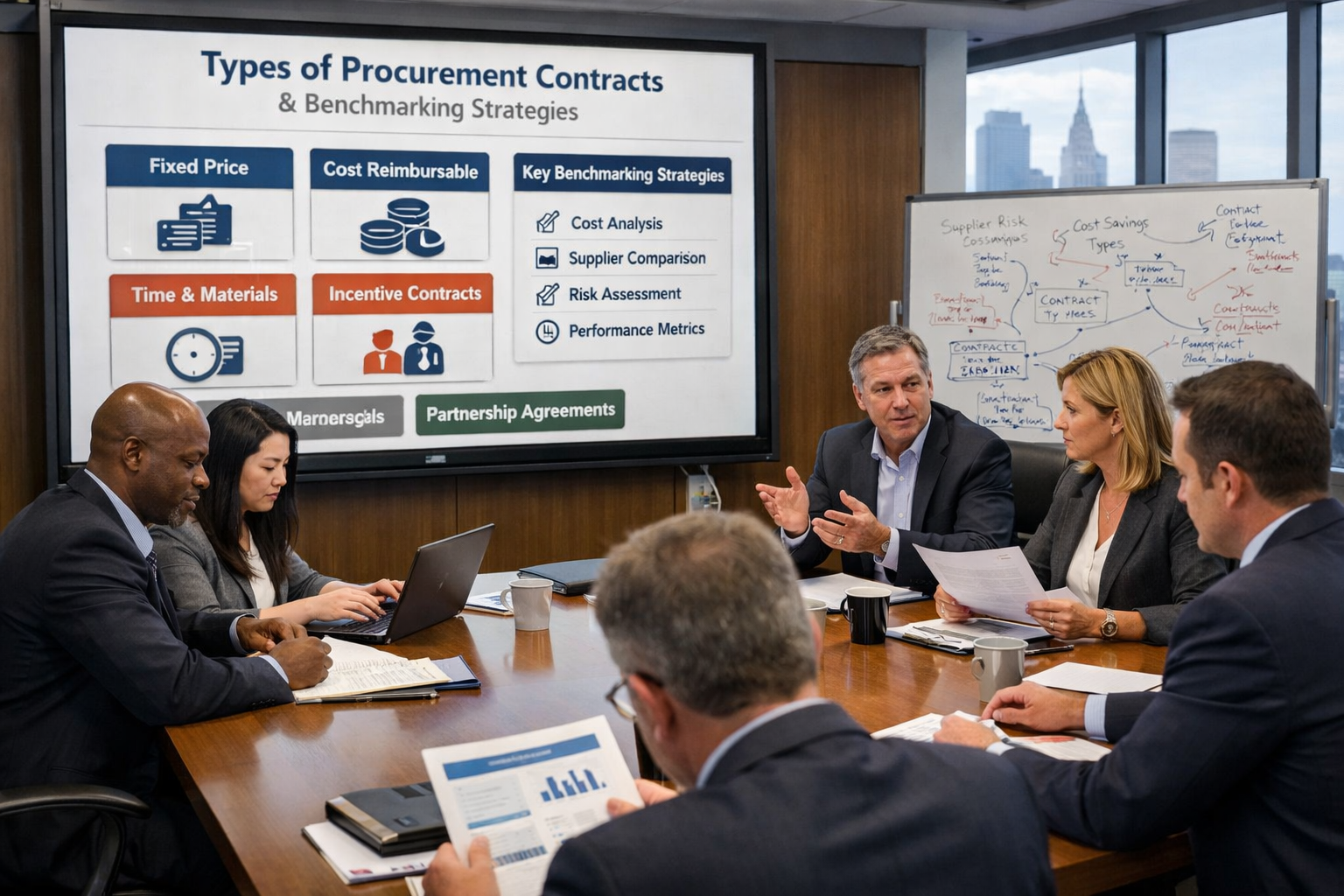
Types of Procurement Contracts | Procurement Benchmarking Guide
%20(4).jpg)
Legal Intelligence Platforms: How Contract Intelligence Drives Better Business Decisions