.png?width=130&height=53&name=Vector%20(21).png "TermScout Logo")

Contract certification began with a straightforward question: Are these terms fair? TermScout built its reputation on answering that question through independent analysis—evaluating whether agreements treat both parties reasonably, contain zero deal breakers, and align with market standards. The Certify™ badge became shorthand for "this contract has been verified as balanced and transparent."
But fairness alone no longer captures the full picture of what buyers need to know before signing. As artificial intelligence becomes embedded in nearly every software product and service, a new category of risk has emerged—one that existing contract certification frameworks weren't designed to address.
Questions about how vendors use customer data to train AI models, whether AI-generated outputs create liability exposure, and how companies handle algorithmic bias don't fit neatly into "customer-favorable" versus "vendor-favorable" ratings. The next evolution of contract certification must expand beyond favorability to address safety.
When "Fair Terms" Stop Being Enough
Traditional contract certification evaluates provisions like liability caps, termination rights, and payment terms. These clauses determine how risk and reward get allocated between parties. The analysis identifies which party gets better terms on each provision.
-1.webp?width=654&height=357&name=image2%20(2)-1.webp)
AI introduces questions that don't map onto this fairness framework. When a buyer asks, "Does this vendor use my data to train their AI models?", the answer isn't "favorable" or "unfavorable"—it's either disclosed or not disclosed.
The Questions That Changed Everything
Consider what procurement teams are actually asking now when they review vendor contracts:
- Data Training: Will our proprietary information be used to improve AI models that our competitors might also access?
- Output Liability: If the AI generates discriminatory or inaccurate content, who bears responsibility?
- Model Transparency: Can we understand how the AI reaches its decisions, especially for regulated industries?
- Compliance Alignment: Do the vendor's AI practices meet evolving regulatory requirements in our jurisdiction?
These questions require disclosure and commitment, not just favorable allocation of traditional contract risks. A contract might be perfectly balanced on payment terms and liability caps while remaining completely silent on AI training data usage.
Why Speed Creates New Problems
The pace of AI development creates unique challenges for contract certification. Regulations are being written in real-time. Industry best practices are still forming. What counts as "responsible AI" in contracts today might look insufficient six months from now.
.webp?width=654&height=776&name=image3%20(3).webp)
This regulatory uncertainty makes buyers nervous. They're signing multi-year agreements with vendors whose AI capabilities and data practices might change substantially before the contract term ends. Without clear contractual commitments around AI usage, buyers face open-ended risk that's difficult to evaluate or price.
What Safe AI Certification Actually Means
Safe AI certification represents a different kind of validation than favorability certification. Instead of evaluating which party gets better terms, it assesses whether the vendor has disclosed key information about AI usage, committed to specific safety practices, and addressed known risk categories.
The Seven Principles That Matter
The certification evaluates vendor contracts across seven evolving categories that address the questions buyers actually care about:
|
Certification Principle |
What It Evaluates |
Why It Matters |
|
Use Restrictions |
What customers can/cannot do with AI service |
Prevents liability from prohibited applications |
|
Transparency & Explainability |
How AI system works and decisions can be understood |
Required for regulatory compliance in many sectors |
|
Data Usage & Ownership |
How customer data trains models or creates outputs |
Protects proprietary information from competitive exposure |
|
Security & Incident Response |
Protections against breaches and response procedures |
Mitigates risk from AI-specific vulnerabilities |
|
Transparent Communication |
Commitments to disclosure about AI changes or incidents |
Ensures ongoing visibility into vendor practices |
|
Best Practice Commitment |
Ongoing adherence to evolving industry standards |
Addresses the rapid pace of AI development |
|
Alignment with applicable AI laws and regulations |
Reduces regulatory risk for both parties |
Use restrictions address what customers can and cannot do with the AI service. Some vendors prohibit using their AI for certain high-risk applications like medical diagnosis or legal advice. Others place no restrictions at all. Safe AI certification verifies whether these restrictions exist and whether they're clearly stated.
Transparency and explainability provisions reveal how the AI system works. Does the vendor explain what data the model was trained on? Can customers request explanations for specific AI-generated decisions? These commitments matter for regulatory compliance in sectors facing algorithmic accountability requirements.
How the Certification Process Actually Works
Building Layers, Not Starting Over
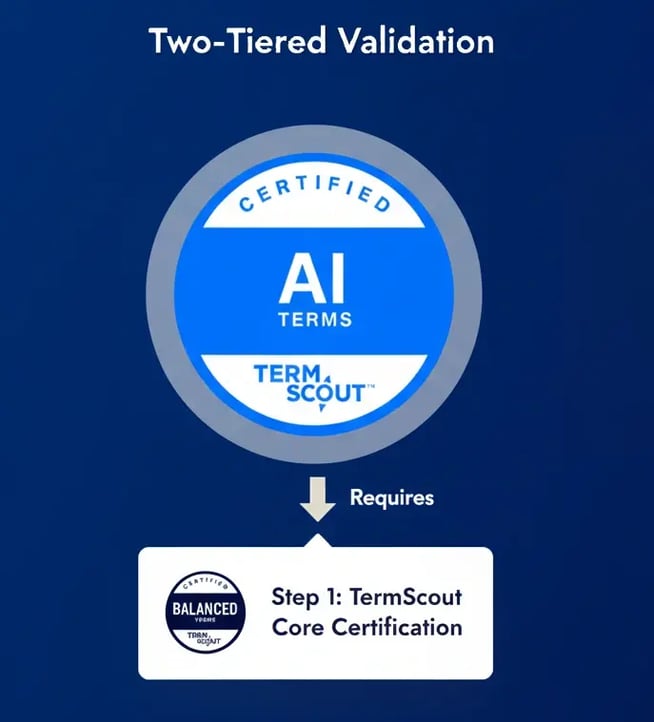
TermScout's approach to safe AI certification builds on top of existing contract certification rather than replacing it. Vendors must first earn the standard Certify™ badge by demonstrating their contracts meet benchmarks for fairness, clarity, and compliance. Only then can they pursue the additional AI-specific certification.
This layered approach makes sense for practical reasons. A contract could have excellent AI transparency provisions but terrible limitation of liability clauses that expose customers to unreasonable risk. Or it might be perfectly balanced on traditional terms, but completely silent on how customer data gets used for AI training.
The AI certification layer focuses specifically on the seven principles outlined earlier. TermScout's analysis examines whether the contract addresses each category and how clearly it does so. A vendor that explicitly states "We do not use Customer Data to train our AI models" gets higher marks than one whose contract is silent on training data usage.
What Those Badges Actually Tell Buyers
When a vendor displays both the standard TermScout Certify™ badge and the safe AI certification badge, they're making two distinct claims:
- Standard Certification: "Our contract terms are fair, balanced, and aligned with market standards"
- Safe AI Certification: "We've also clearly addressed AI-specific risks, disclosed our data practices, and made verifiable commitments about transparency and compliance"
Buyers seeing both badges can move forward with more confidence. They know the contract has been independently reviewed for both traditional fairness and AI-specific safety considerations. This doesn't eliminate all risk—no certification can do that—but it provides third-party validation that key questions have been addressed.
The certification also creates a feedback loop for continuous improvement. As new AI risks emerge and regulatory frameworks develop, the certification standards can evolve. Vendors who want to maintain their safe AI certification need to update their contractual commitments to address newly recognized risk categories.
Who Actually Benefits (And How)
-1.webp?width=654&height=399&name=image4%20(1)-1.webp)
Sales Teams: From Friction to Fast-Track
AI terms often stall deals as buyers grill sales on data usage and bias. Safe AI certification flips the script:
- Proactive Trust: Shifts the talk from risk mitigation to proven compliance.
- Competitive Edge: Serves as a tie-breaker against uncertified rivals.
- Faster Cycles: Pre-vetted terms reduce legal back-and-forth, accelerating deal velocity.
Legal Departments: Strategic Efficiency
In-house counsel are overwhelmed by new AI risks like algorithmic accountability. Certification provides a trusted baseline, allowing legal teams to skip standard AI clause reviews and focus only on high-risk, specialized provisions. As AI becomes ubiquitous, this efficiency is essential for scaling operations.
Procurement: Standardized Evaluation
Procurement often struggles to compare inconsistent AI vendor commitments. Certification replaces guesswork with an independent benchmark:
|
Feature |
Without Certification |
With Safe AI Certification |
|
Risk Clarity |
Hidden or vague AI risks |
Seven key principles evaluated |
|
Comparison |
Apples-to-oranges |
Standardized framework |
|
Validation |
Subjective vendor claims |
Independent third-party audit |
Ultimately, certification ensures a vendor has disclosed their practices clearly enough to be judged, simplifying the internal path to approval.
Why Disclosure Beats Promises Every Time
The evolution from favorability certification to safe AI certification reflects a broader shift in how contract intelligence serves its users. Early contract analysis tools provided binary assessments: favorable or unfavorable, compliant or non-compliant, acceptable or unacceptable.
AI introduces questions where the right answer is "it depends" or "here's what the vendor disclosed, and here's what remains ambiguous." Safe AI certification embraces this nuance. Rather than claiming a contract is "safe" or "unsafe," it validates that specific categories of information have been disclosed and specific commitments have been made.
This approach recognizes that different buyers have different risk tolerances and different regulatory requirements. A healthcare provider evaluating AI contracts might focus intensely on data usage and model explainability given HIPAA obligations. A financial services firm might prioritize security and incident response provisions.
When Honesty About Risk Works Better Than Hiding It
The emphasis on disclosure rather than risk elimination reflects practical reality. AI systems will always carry some level of risk. Models can produce biased outputs. Training data might contain sensitive information. Algorithmic decisions might be difficult to explain.
Vendors can't promise perfect safety, but they can commit to transparency about limitations and clear processes for addressing problems when they arise. Safe AI certification rewards vendors who acknowledge risks openly rather than hiding them in vague language or omitting them entirely.
Consider two different contractual approaches:
Vague Promise: "Our AI models provide fair and unbiased outputs"
- Sounds good, but is effectively unverifiable
- Creates liability exposure when outputs inevitably show some bias
- Provides no framework for addressing problems
Clear Disclosure: "Our AI models may reflect biases present in training data; we commit to ongoing bias testing and correction procedures documented in Exhibit B"
- Acknowledges realistic limitations
- Creates specific, measurable commitments
- Provides a framework for continuous improvement
The second approach provides more useful information for buyers making decisions and creates better incentives for vendors to maintain transparent practices.

What This Means for the Industry
The seven principles underlying safe AI certification—use restrictions, transparency, data handling, security, communication, best practices, and compliance—will themselves evolve as understanding of AI risks develops. What matters most is establishing a framework for systematic disclosure and verification that can adapt.
For vendors, pursuing safe AI certification means committing to transparency even when it reveals limitations or risks. That's uncomfortable but ultimately beneficial. Buyers increasingly demand this transparency anyway—better to address it proactively with certified commitments than reactively during negotiations on every deal.
For buyers, recognizing safe AI certification provides a starting point for evaluation rather than an endpoint. Certification validates that key disclosures have been made and certain commitments exist. What buyers do with that information—whether the disclosed practices meet their specific needs and risk tolerance—remains a judgment call that certification can inform but not replace.
Why the Two-Badge System Works
The combination of standard contract certification and safe AI certification creates a comprehensive trust signal. The first badge says "We've addressed traditional contract fairness." The second adds "we've also tackled AI-specific risks with clear disclosure."
This two-tier approach allows the market to evolve naturally. Vendors can pursue standard certification first, then add AI certification as their products and practices mature. Buyers can prioritize AI certification for vendors whose products heavily rely on AI functionality while accepting standard certification alone for vendors using AI more peripherally.
Beyond Today's Risks to Tomorrow's Challenges
Contract certification started with fairness because that's where the immediate market need existed. Buyers wanted validation that vendor terms weren't unreasonably one-sided. Vendors wanted proof they could provide to accelerate deals. Favorability certification addressed both needs by providing independent benchmarking against market standards.
But as technology evolves, certification must evolve with it. Safe AI certification represents the next step—expanding beyond "are these terms fair?" to "have the risks been clearly disclosed?" This shift acknowledges that some of the most important contract provisions can't be evaluated on a simple favorability spectrum.
The future of contract certification lies not in providing increasingly definitive judgments about whether contracts are "good" or "bad," but in systematically surfacing the information both parties need to make informed decisions. Safe AI certification takes a step in that direction by acknowledging that transparency about risk matters as much as fairness in the allocation of that risk.
As new categories of risk emerge—and they will—the certification framework can expand to address them while maintaining the core principle: disclose clearly, commit specifically, and verify independently. TermScout ensures that a certification badge is not a static seal of approval, but a dynamic signal of a vendor’s commitment to safety as technology and regulations shift.
Get certified with TermScout today — Join the new standard of AI trust.
Share this
-Mar-02-2026-02-12-28-0324-PM.webp)
AI Contract Terms: How to Prepare for Emerging Industry Benchmarks
-Mar-02-2026-02-02-28-2638-PM.webp)
How Third-Party Certification Beats AI Point Tools
-Mar-02-2026-01-28-20-0687-PM.webp)