.png?width=130&height=53&name=Vector%20(21).png "TermScout Logo")

TermScout has built its reputation on objective contract evaluation. The platform analyzes over 750 data points in every agreement, scores them algorithmically, and produces ratings that legal, procurement, and sales teams trust. These ratings determine which contracts earn the Certify™ badge—independent validation that terms are balanced, customer-favorable, and free from deal breakers.
But there's a category of provisions conspicuously absent from this scoring methodology: AI clauses in contracts. Provisions about training data usage, model transparency, algorithmic accountability, and AI-specific security don't currently factor into TermScout's favorability ratings.
This isn't an oversight. It's a deliberate choice rooted in how contract intelligence should work when the underlying standards are still forming. The decision reflects a broader principle about what makes contract certification credible: scoring requires benchmarks. For traditional provisions, these benchmarks exist. For AI clauses, they're still taking shape.
Why Traditional Scoring Breaks Down for AI Provisions
TermScout's favorability scoring works because it compares each contract against a massive database of real-world agreements. When the platform analyzes a limitation of liability clause, it can determine whether that provision is more vendor-favorable, more customer-favorable, or balanced compared to thousands of similar clauses.
This comparison only works when market practices have stabilized enough to create meaningful benchmarks. For mature contract provisions, clear patterns emerge. Most SaaS contracts cap liability at 12 months of fees paid. Deviation from this norm signals whether a particular contract tilts vendor-favorable or customer-favorable.

The Missing Standard Problem
AI clauses in contracts lack this maturity. Consider training data usage provisions:
- Some vendors explicitly prohibit using customer data to train AI models
- Others reserve broad rights to use customer data for "service improvement"
- Still others allow training on aggregated data, but not individual customer information
- Many contracts remain completely silent on training data usage
Which approach represents the "market standard"? The honest answer right now is: there isn't one. The market is still figuring out appropriate boundaries. Vendors are experimenting with different approaches. Buyers are developing preferences based on their specific risk tolerances.
When Different Doesn't Mean Wrong
Even within specific industries or deal sizes, AI clauses in contracts show remarkable variation. Two enterprise SaaS vendors with similar products might take completely opposite approaches to data training rights.
Neither approach is objectively "wrong" or "unfavorable"—they reflect different business models and value propositions. A buyer who wants their data to improve the product might prefer broad usage rights. A buyer concerned about proprietary information leaking into competitor-accessible models would prefer strict prohibitions.
Traditional favorability scoring assumes that more permissive terms for customers are "better." But with AI clauses in contracts, this assumption breaks down. Sometimes, specific restrictions protect both parties by reducing liability exposure. Sometimes, broad permissions enable functionality that customers actually want.
The Silence Problem
Another challenge: many contracts simply don't address AI-specific issues yet. When TermScout analyzes a contract that's silent on training data usage, how should that silence be scored?
Possible interpretations of contract silence:
- Vendor-favorable because it leaves the vendor free to train on customer data
- Customer-favorable because no explicit permission was granted
- Neutral because neither party contemplated AI functionality when drafting
- Impossible to determine without additional context
For mature provisions, contract silence usually carries clear implications. If a contract doesn't include a limitation of liability clause, that absence is vendor-favorable—the vendor faces unlimited liability. But for AI clauses, silence might mean anything from "we're not using AI at all" to "we're using AI extensively but haven't updated our contracts yet."
What Safe AI Certification Does Instead
The key insight driving safe AI certification is that AI clauses require a different evaluation framework. Instead of asking "which party gets more favorable terms?", the relevant question becomes "has the vendor clearly disclosed their AI practices and committed to specific standards?"
-3.webp?width=654&height=357&name=image3%20(1)-3.webp)
Disclosure Beats Favorability Rankings
This shift from favorability to disclosure reflects the nature of AI risks. Traditional contract provisions allocate known risks between parties. Both sides understand what liability caps do, what termination rights enable, and what payment terms require.
AI clauses in contracts often address risks that are still being understood. Questions about how training data affects model behavior, whether AI outputs create copyright liability, or how to audit algorithmic decision-making don't have settled answers. In this environment, disclosure matters more than allocation.
Safe AI certification evaluates whether contracts address key disclosure categories:
- Use Restrictions - What customers can and cannot do with the AI service
- Transparency & Explainability - How AI systems work, and decisions can be understood
- Data Usage & Ownership - How customer data trains models or creates outputs
- Security & Incident Response - Protections against AI-specific vulnerabilities
- Transparent Communication - Commitments to disclosure about changes or incidents
- Best Practice Commitment - Ongoing adherence to evolving standards
- Legal Compliance - Alignment with applicable AI laws and regulations
The certification doesn't rate whether the vendor's approach to each category is more or less favorable than competitors. It validates that the vendor has addressed the category clearly enough for buyers to make informed decisions.
Why This Approach Actually Works
The seven principles provide structure without imposing rigid favorability judgments. Take the "use restrictions" principle. Certification evaluates whether the contract clearly states what customers can and cannot do with the AI service—not whether those restrictions are "favorable" to customers.
A vendor might prohibit using their AI for medical diagnosis, legal advice, or autonomous vehicle control. These restrictions limit customer flexibility, which traditional scoring might classify as vendor-favorable. But they also protect customers from liability exposure in high-risk applications. The restrictions themselves are neither favorable nor unfavorable—they're disclosure of important limitations.
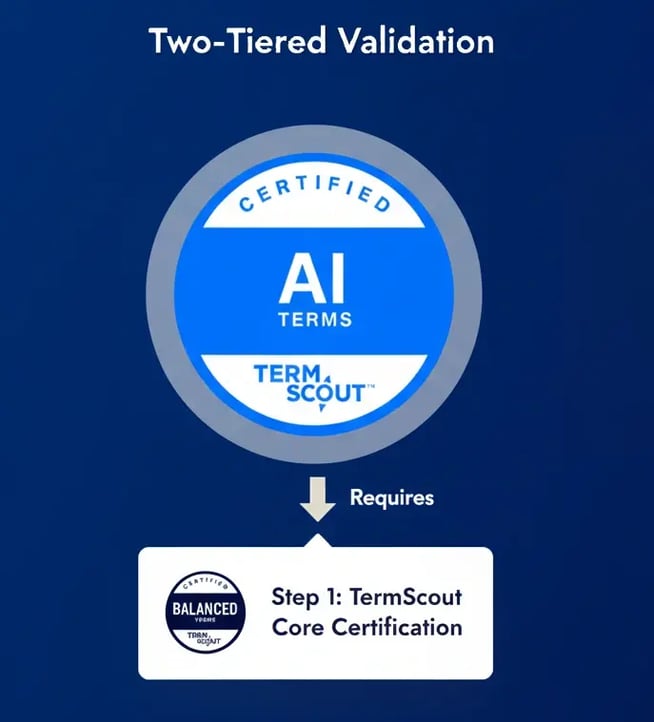
The Two-Tier Structure That Makes Sense
Why Core Certification Comes First
TermScout's approach requires vendors to earn core Certify™ certification before pursuing safe AI certification. This sequencing is intentional. Core certification validates that the contract's traditional provisions—liability, indemnification, warranties, payment terms—meet standards for fairness and contain no deal breakers.
A contract could have excellent AI disclosure provisions but terrible limitation of liability clauses that expose customers to unreasonable risk. Or it might be perfectly balanced on traditional terms while remaining completely silent on AI-specific concerns. Comprehensive evaluation requires both lenses.
The two-tier structure also acknowledges that not every contract needs AI-specific certification. Vendors whose products use AI minimally might only need core certification. Those whose value proposition centers on AI capabilities should pursue both certifications to address the full range of buyer concerns.
What Happens As Standards Mature
As market practices around AI clauses in contracts mature, some aspects of AI certification might eventually migrate into traditional favorability scoring. If clear benchmarks emerge—say, industry consensus that training data usage requires opt-in customer consent—TermScout's scoring methodology could begin evaluating whether specific contracts meet that benchmark.
But this transition will happen selectively and only when the data supports it. Different aspects of AI contract terms will mature at different rates, and the evaluation approach should match the maturity level of each provision type.

Who Benefits From This Approach
- Legal Teams: Gain a disclosure-focused framework that replaces vague "favorability" ratings with hard facts. This allows counsel to bypass guesswork and verify if specific AI commitments meet company standards.
- Procurement: Enables "apples-to-apples" comparisons between complex AI contracts. By using standardized disclosure principles, teams can evaluate vendor transparency without relying on oversimplified or arbitrary scores.
- Sales Teams: Provides a powerful trust signal by combining balanced contract terms with clear AI disclosures. This proactive approach reduces deal friction and offers a competitive edge over vendors with vague data policies.
Building Trust Through Honesty
Excluding AI clauses from favorability scoring isn't a limitation of TermScout's methodology—it's a feature. Contract intelligence that acknowledges when benchmarks don't exist yet builds more trust than analysis that manufactures scores where comparison lacks meaning.
AI clauses in contracts represent genuinely new territory where market practices are still forming. Forcing these provisions into evaluation frameworks designed for mature contract terms would produce unreliable results that mislead users.
Safe AI certification provides what AI clauses actually need: systematic evaluation of whether vendors have disclosed their practices clearly, committed to specific standards across key risk categories, and addressed the concerns that sophisticated buyers are asking about.
For vendors, this approach offers credibility. Earning both certifications proves commitment to fairness in traditional terms and transparency in AI practices. For buyers, it provides a structure for evaluating vendor contracts systematically without imposing premature standardization on provisions where legitimate diversity still exists.
The path forward is clear: core certification for traditional provisions through proven favorability scoring, and safe AI certification for AI-specific provisions through disclosure-based evaluation. Both frameworks serve users by providing honest, useful information—never pretending certainty where ambiguity remains.
Share this
-Mar-26-2026-11-50-49-4101-AM.webp)
The Last Mile of Due Diligence: Evaluating Vendor Liability in the AI Era

Why AI-Drafted Contracts May Be Making Agreements Worse
-3.webp)