.png?width=130&height=53&name=Vector%20(21).png "TermScout Logo")

Every AI contract mentions "artificial intelligence" or "machine learning" somewhere. But most are silent on the questions that actually matter.
Does the vendor train models on your data? If so, which data? Does the AI make decisions autonomously or recommend options for human review? Can you audit how it reached a decision? Most contracts never say.
This opacity isn't an edge case. It's the norm. And it makes meaningful AI procurement impossible.
The industry has been debating "responsible AI practices" and "ethical frameworks" while ignoring a more fundamental gap: vendors aren't required to disclose basic facts about what their AI actually does. Without disclosure, no standard (best practice or otherwise) can protect you. You're buying blind.
This matters more in 2026 than ever. AI regulation is accelerating. Audit requirements are tightening. Liability exposure is expanding. Contracts with vague AI provisions won't survive regulatory scrutiny. Contracts with clear, specific disclosures will.
The Problem: Best Practices Don't Work Without Disclosure
-Mar-02-2026-12-41-23-1287-PM.webp?width=654&height=412&name=image3%20(1)-Mar-02-2026-12-41-23-1287-PM.webp)
Why Standards Fail When Disclosure Is Missing
Best practice frameworks assume shared understanding. When vendors claim to follow "responsible AI principles," procurement teams can't evaluate that claim because they don't know what the vendor's AI actually does.
Traditional software contracting works because both parties understand the activity. Database hosting means something specific. API access has predictable implications. Buyers can assess whether vendor practices meet standards because they understand what's happening.
AI contracting lacks this foundation.
The Information Gaps That Kill Contract Analysis
Consider what most procurement teams don't know about their AI vendors:
- Training data usage. Does the vendor use your data to train models? If so, do other clients benefit, or only you?
- Decision-making authority. Does the AI make autonomous decisions, or does it recommend options for human review?
- Explainability. Can the vendor explain how the AI reached a specific decision, or is it a black box?
- Auditability. Do you have access to decision-making logic, or must you trust vendor claims about how it works?
- Error handling. When the AI makes mistakes, what's your recourse?
Without answers to these questions, contract benchmarking becomes an abstract exercise. You're comparing vague claims, not actual practices. And you're exposed to risks you haven't identified because the contract never disclosed them.
This is why disclosure must come first. Without it, best practice guidelines become theater. Vendors claim to follow standards while actual practices remain hidden.
The Disclosure Framework: What Vendors Must Tell You
Effective AI disclosure standards address specific categories. These aren't exhaustive, but they represent the minimum information buyers need for informed procurement decisions.
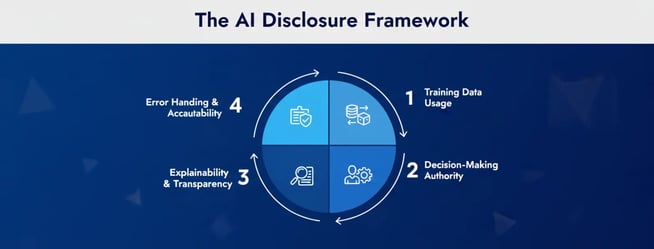
Essential Disclosure Category #1: Training Data Usage
This is the foundational disclosure. Contracts should state:
- Whether the vendor uses customer data to train AI models
- Which data types are used (customer content, metadata, usage patterns, all of the above)
- Whether training benefits only you or other vendor clients
- Whether customers can opt out
- How long the vendor retains data after the contract ends
This isn't asking vendors to change their practices. It's asking them to clearly state what those practices are.
Why it matters: If a vendor trains models on your proprietary data and licenses those models to competitors, that's a material contract risk you should know about upfront.
Essential Disclosure Category #2: Decision-Making Authority
Contracts should specify:
- Whether the AI makes decisions autonomously or generates recommendations for human review
- What inputs the AI considers when making decisions
- Which business processes rely on AI decision-making
- What happens when decisions are wrong (recourse, reversal process, liability)
- Whether decisions are final or appealable
Why it matters: If your vendor's AI makes autonomous decisions about customer eligibility, pricing, or risk, you need to know it's operating at that level of authority before deployment.
Essential Disclosure Category #3: Explainability and Transparency
Contracts should address:
- Whether vendors can explain how specific AI decisions were reached
- Whether customers have access to decision-making logic or model inputs
- What transparency commitments the vendor makes in writing
- How quickly vendors can provide explanations (24 hours, 48 hours, case-by-case)
- Whether the AI can be audited by third parties
Why it matters: You can't defend an AI-driven decision you can't explain. Regulators won't accept "the AI decided" as justification. Your customers won't either.
Essential Disclosure Category #4: Bias Testing and Validation
Contracts should state:
- Whether the vendor conducts bias testing on AI models
- How frequently testing occurs and which metrics are measured
- Whether results are shared with customers and how
- What happens when bias is detected (model adjustments, customer notification, etc.)
- Whether the vendor provides documentation of validation processes
Why it matters: AI models inherit biases from training data. Contracts that don't require disclosure of testing create compliance risk and potential liability.
How Contract Intelligence Reveals What Vendors Actually Disclose
Manual review of AI contracting provisions is impractical. Vendors disclose AI practices inconsistently: sometimes in the master agreement, sometimes in privacy policies, sometimes in technical documentation. Some bury critical information in appendices or vendor-published guides.
Contract Intelligence tools solve this by automatically extracting AI-related provisions regardless of location or terminology used. The system identifies sections covering:
- Training data practices
- Model decision-making processes
- Explainability commitments
- Bias testing and validation
- Error handling and recourse
- Data retention and deletion
This extraction accomplishes two things:
First, it makes disclosure visible. Instead of manually searching for scattered references, procurement teams see what each vendor has actually committed to.
Second, it flags disclosure gaps. When a contract mentions using AI but doesn't address training data usage, the absence gets flagged. When a vendor promises "transparent AI" but the contract doesn't define what transparency means, the gap is documented.
These gaps become negotiation points: either the vendor clarifies practices in writing, or procurement identifies unacceptable risk.
Comparison: Vague Claims vs. Specific Disclosures
| Dimension | Vague Best Practice Claim | Specific Contractual Disclosure |
|---|---|---|
| Enforceability | Aspirational; vendor can change practices without notice | Binding commitment; requires contract amendment to change |
| Audit compatibility | "Complies with responsible AI" doesn't prove anything | "Tests models quarterly using fairness metrics X, Y, Z" is auditable |
| Regulatory readiness | Regulators won't accept vague claims as evidence of compliance | Specific disclosures create documentation trail regulators expect |
| Buyer confidence | Unknown what vendor actually does | Clear baseline established; buyer can compare vendors meaningfully |
| Market differentiation | All vendors claim responsibility; no competitive distinction | Vendors with strong disclosures stand out |
| Risk allocation | Buyer discovers problems through experience | Buyer understands risk before signing |
Turning Disclosure Into Binding Commitments
The shift from vague claims to specific disclosures changes everything about vendor accountability.
When a vendor states in writing: "We do not use customer data to train models that serve other clients," that's a contractual promise. Violating it is a breach. When a vendor writes "Customers can request AI decision explanations within 48 hours," that's a service level commitment, not an aspiration.
This specificity also changes how contracts age. As AI practices evolve, clear disclosures establish what was promised at the time of signing. If a vendor later changes training practices, the amendment must be explicit and negotiated.
Why Written Commitments Survive Regulatory Review
Regulators evaluating AI risk don't care about best practice claims. They care about what vendors committed to do.
Here's how disclosure-first contracts survive regulatory scrutiny:
- Auditors see commitments, not aspirations. When regulators ask "What did your vendor commit to regarding model explainability?" you can point to the specific contractual language.
- Documentation trails exist. When regulations require proof that vendors validate models for bias, contracts with bias testing disclosures create the audit trail compliance requires.
- Gaps are identifiable. When new regulations require specific AI safeguards, you can quickly identify whether your existing contracts address them.
Vague references to "responsible practices" don't enable this level of compliance verification.

How Certification Validates AI Disclosure Adequacy
TrustMark certification evaluates whether contracts provide adequate disclosure around AI-specific practices and risks. This isn't judgment about whether vendor AI practices are "good" or "bad". It's verification that the contract clearly discloses what those practices are.
What Certification Assesses
Vendors pursuing certification must ensure contracts address disclosure categories systematically:
- Training data usage is specified, not vague
- Decision-making authority is clear and bounded
- Explainability commitments are concrete and measurable
- Bias testing practices are documented
- Error handling and recourse mechanisms are defined
Generic statements like "We use AI to improve services" don't suffice. Contracts need specificity: "Our AI uses customer usage data (not content) to recommend features, with weekly model updates shared via dashboard."
What Certification Means for Procurement
For procurement teams, TrustMark certification provides assurance that AI disclosures meet minimum completeness standards. The certification confirms that:
- The vendor has disclosed enough information for informed procurement decisions
- Critical AI-related practices are addressed in the contract, not left to assumption
- Disclosure gaps have been identified and addressed
- The contract supports regulatory compliance and audit readiness
This differentiation matters. A vendor with TrustMark certification signals transparency. A vendor avoiding certification raises questions about what they're hiding.
The Market Advantage: How Disclosure Drives Competitive Differentiation
Once disclosure standards establish what information vendors must provide, market dynamics begin rewarding vendors whose practices buyers prefer.
How Transparency Creates Competitive Pressure
Procurement teams comparing AI vendors can now see concrete differences:
- Vendor A trains models on customer data; Vendor B doesn't
- Vendor A provides quarterly bias reports; Vendor B is silent on testing
- Vendor A commits to 24-hour explainability turnaround; Vendor C won't commit to timing
- Vendor B provides third-party audit rights; Vendor A doesn't
This visible differentiation changes procurement conversations. Vendors whose disclosed practices create buyer concerns face questions during evaluation. Those with practices buyers prefer gain advantage.
Why Organic Market Evolution Beats Top-Down Standards
The pressure vendors face isn't from compliance mandates. It's from losing deals to competitors with better disclosure.
Over time, this pressure drives vendors toward practices the market rewards. But the evolution happens organically based on what actual buyers select, not what industry groups prescribe. Different procurement teams weight AI risks differently based on their industry, use case, and risk tolerance.
The practices that emerge as dominant are those that real buyers chose through informed procurement, not those that consultants recommended.
Building Contracts That Survive the AI Regulatory Wave
Regulatory frameworks for AI are accelerating. EU AI Act requirements are tightening. SEC guidance on AI governance is expanding. Audit firms are scrutinizing AI contracting as part of standard reviews.
Contracts built on disclosure-first foundations are positioned to meet these requirements. Contracts built on vague best practice claims will fail audit review.
Why Specific Disclosures Pass Regulatory Scrutiny
When auditors review AI governance, they ask: "What did your vendors commit to regarding explainability, bias testing, and data usage?"
If the contract says "We use responsible AI principles," the audit fails. That's not a commitment; it's rhetoric.
If the contract says "Vendors must provide quarterly bias testing reports; we maintain 90-day audit trails; models are retrained if disparate impact exceeds 5% on protected classes," the audit passes. That's evidence.
Regulatory readiness is why disclosure standards matter more than best practice adherence claims. Vague references don't create the documentation trail compliance requires. Specific disclosures do.
Procurement Action Plan: Demanding AI Disclosure
Procurement teams evaluating AI-powered products should establish minimum disclosure requirements that vendors must meet for contracts to advance.
These requirements don't dictate what AI practices are acceptable. They define what information vendors must provide for procurement to make that determination.
Minimum Disclosure Checklist for AI Contracts
Before signing any AI-powered software contract, verify that disclosures address:
- Training data. Which data types does the AI use? Do other clients benefit?
- Decision authority. Is the AI autonomous or recommending? What recourse exists?
- Explainability. Can vendors explain specific AI decisions? Within what timeframe?
- Bias testing. Does vendor conduct testing? How? Are results shared?
- Error handling. What happens when AI makes mistakes? What's your remedy?
- Auditability. Can you audit the AI or must you trust vendor claims?
- Data retention. How long after contract ends does vendor keep your data?
Vendors who can't or won't provide these disclosures signal problems. Procurement can use contract transparency as a filter, prioritizing vendors who demonstrate clarity.
How TrustMark Certification Creates Competitive Advantage
Vendors serious about transparency can pursue TrustMark certification. The process evaluates whether contracts address key disclosure categories with sufficient specificity.
For vendors: Certification provides independent verification that AI disclosures meet standards, differentiating them from competitors with vague AI provisions. It also helps identify disclosure gaps before they become procurement obstacles.
For buyers: Certification signals that vendors have committed to transparency in writing. Certified contracts provide the AI-related information needed for informed procurement and regulatory readiness.
-Mar-02-2026-12-49-01-1450-PM.webp?width=654&height=361&name=image2%20(1)-Mar-02-2026-12-49-01-1450-PM.webp)
Frequently Asked Questions
1. Don't "best practices" frameworks cover AI disclosure?
Most frameworks focus on practices vendors should adopt, not information vendors must disclose. There's a critical difference. A vendor can claim to follow "responsible AI principles" while disclosing nothing about what those principles mean in their contract. Disclosure standards are enforceable; best practice claims are not.
2. If we demand disclosure, won't vendors refuse to sign?
No. Vendors who can't disclose what their AI does have a bigger problem. They don't understand their own products well enough to manage risk. Vendors with mature, understood AI practices can disclose them easily. Pushback on disclosure is a red flag.
3. What if a vendor says "AI specifics are proprietary"?
Vendors can protect proprietary algorithms while still disclosing practices. "Our proprietary ML model uses your usage data to predict feature adoption" discloses practice without revealing algorithm. If vendors refuse even this level of disclosure, their AI contracting isn't mature enough for enterprise purchase.
4. How does disclosure help with regulatory compliance?
Regulators ask about vendor commitments, not aspirations. When auditors ask "What did your vendor commit to regarding bias testing?", contracts with specific disclosures create the documentation trail regulators expect. Vague references to "responsible practices" fail audit.
5. Should disclosure requirements differ by industry?
Yes. A healthcare organization's disclosure requirements differ from SaaS. A financial services firm cares about explainability and bias testing differently than a marketing team. Establish minimum disclosure categories, then prioritize based on your risk profile.
The Real Competitive Advantage: Contracts That Prove Compliance
The companies winning AI contracts in 2026 aren't those with the most advanced AI features. They're those whose contracts clearly disclose what the AI does.
Procurement teams increasingly reject vague AI provisions. They demand specific commitments. They want to understand vendor practices before deployment, not discover problems afterward.
Vendors who build disclosure-first contracts (who commit to specificity about training data, decision-making, explainability, and bias testing) differentiate themselves in procurement.
Buyers who establish disclosure requirements (who refuse vague AI provisions and demand specific commitments) protect themselves from risk while positioning contracts to survive regulatory review.
The future of AI contracting isn't about best practices. It's about disclosure. Specific, binding, auditable disclosure that creates accountability and enables informed procurement.
That's where competitive advantage lives in 2026.
Discover how TrustMark certification helps vendors meet AI disclosure standards and buyers verify contract transparency.
Share this

5 Reasons AI Terms Are Becoming the New Deal Breaker (and What You Can Do About It)
-Mar-02-2026-01-28-20-0687-PM.webp)
AI Badges Aren't About Compliance—They're About Defensibility
%20(13)-1.jpg)